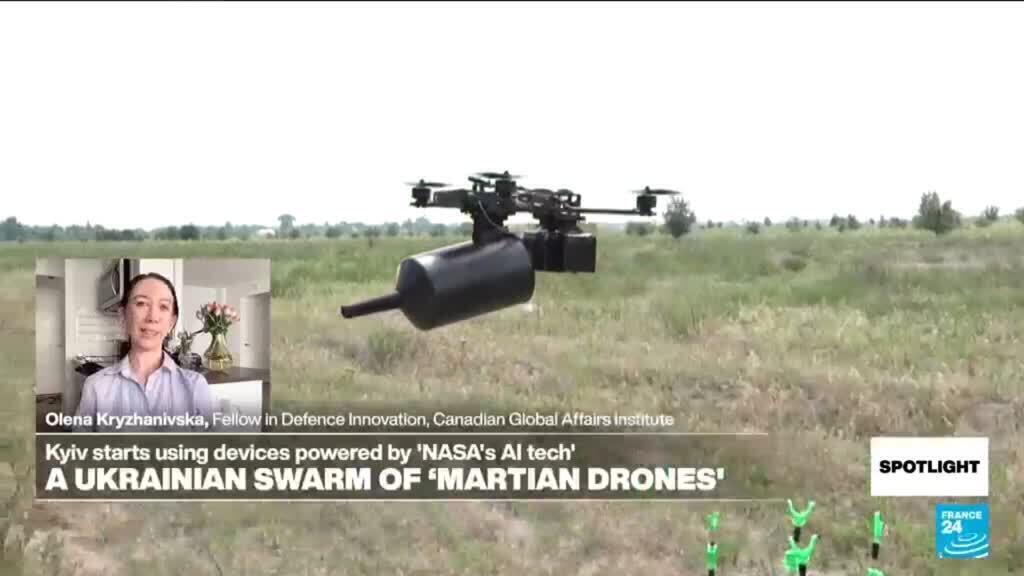
Ukraine's frontlines are no longer just trenches and artillery duels. They are becoming killing zones where unmanned systems decide who lives and who dies. In the past six months alone, Ukrainian forces have deployed drones capable of striking targets up to 1,000 kilometers inside Russian territory, far beyond the range of most Western-supplied systems. These aren't just surveillance tools anymore. They are precision strike weapons, rescue platforms, and psychological instruments of war. And they are changing the calculus of a conflict that has already redefined modern warfare.
The drones that are quietly rewriting the rules of war
This isn't the drone war of 2022, when hobbyist quadcopters dropped grenades on unsuspecting Russian troops. Today, Ukraine is fielding long-range, AI-assisted drones that can loiter for hours, identify targets automatically, and strike with devastating accuracy. Reports from France 24 describe systems codenamed "Martian drones" by Russian forces, which are believed to operate beyond visual line of sight and use swarm tactics to overwhelm air defenses. These drones are not only reshaping frontline dynamics, they are forcing Moscow to divert billions in air defense upgrades to counter a threat it once dismissed as secondary.
But the implications go far beyond Ukraine. The proliferation of advanced unmanned systems is accelerating a global arms race. Nations from Turkey to India, and yes, even in South Asia, are watching closely. The question isn't just whether Ukraine can push Russia out of occupied territory, it's whether the drone revolution will force a fundamental rethink of how wars are fought in the 21st century. And if so, what does that mean for countries that have yet to fully integrate drones into their military doctrine?
Why this matters: The dawn of the drone-centric battlefield
This conflict has become the laboratory for the future of warfare. Unlike traditional artillery or aircraft, drones offer something unprecedented: persistence. They can remain airborne for days, relay real-time intelligence, and deliver kinetic effects without risking pilots. According to reporting by France 24, Ukrainian forces used drones not only to conduct strikes but also to evacuate civilians, including a 77-year-old woman in the Odesa region during a recent Russian missile barrage. That dual-use capability, both offensive and humanitarian, is redefining what it means to project power.
Militarily, the shift is tectonic. Russia, which once dominated the skies with its air force, now finds itself on the defensive against a swarm of smaller, cheaper, and harder-to-intercept threats. The cost ratio is staggering: a Ukrainian drone can cost as little as $5,000 to build and deploy, while intercepting it with a surface-to-air missile can run into the millions. That asymmetry is unsustainable for any military relying on traditional platforms. Strategically, it means that even a technologically inferior force, if it can master drone warfare, can impose disproportionate costs on a stronger adversary.
And then there's the psychological dimension. Russian troops have reported being haunted by the constant buzz of drones overhead, knowing that at any moment, a strike could come from the sky. That fear alone is eroding morale and forcing changes in tactics. Units that once operated with relative impunity are now forced to dig deeper, move faster, and rely more on electronic warfare to jam drone signals. The battlefield is no longer just about territory, it's about information dominance, real-time decision-making, and the ability to project force without boots on the ground.
From the Donbas to the Dnieper: A brief history of Ukraine's drone evolution
The story of Ukraine's drone revolution didn't begin in 2022. It started in 2014, when Russia first annexed Crimea and fomented conflict in the Donbas. Back then, Ukrainian forces were outgunned and outmatched. Their response? Innovation. Civilian tech enthusiasts, defense startups, and volunteer groups began modifying commercial drones for military use. By 2016, Ukraine had established the first dedicated drone unit within its armed forces. By 2019, it was training soldiers to operate first-person-view (FPV) drones for reconnaissance and strike missions.
The turning point came in 2022, when Russia launched its full-scale invasion. Within weeks, Ukrainian forces were deploying domestically produced drones like the "Bober" (Beaver) and "Punisher" to conduct precision strikes on Russian command posts, ammunition depots, and even airfields. These systems were not built in secret labs, they were developed in garages, funded by crowdfunding, and tested in real combat. By 2023, Ukraine had established a dedicated drone command within its military, with brigades trained specifically to operate unmanned systems at scale.
But the real game-changer arrived in late 2024, when Ukraine began fielding long-range drones capable of reaching Moscow. These systems, often launched from deep within Ukrainian territory, forced Russia to divert air defense resources from the frontlines to protect its own cities. The psychological impact was immediate. Russian officials, who had long dismissed Ukrainian drone capabilities as "terrorist tactics," were now forced to acknowledge that their homeland was no longer a sanctuary. The shift mirrored a similar evolution in the 2006 Lebanon War, when Hezbollah's use of anti-tank guided missiles forced Israel to rethink its doctrine of air superiority. Only this time, the weapon wasn't a guided missile, it was a drone, and it was cheaper, more adaptable, and harder to counter.
What happened: The latest escalation in Ukraine's drone war
According to reporting by France 24, Ukrainian forces have recently intensified their use of advanced drone systems, including what Russian troops have codenamed "Martian drones." These systems are believed to operate in swarms, using AI-assisted target recognition to identify and strike high-value assets such as radar installations, air defense systems, and command centers. The drones are reportedly capable of flying up to 1,000 kilometers, making them one of the longest-range unmanned systems currently deployed in the conflict.
The escalation comes amid a broader Ukrainian push to degrade Russia's logistical and command networks. In recent weeks, Ukrainian drones have targeted oil depots in Belgorod, railway junctions in Bryansk, and even a military airfield in Pskov, all deep inside Russian territory. The strikes have forced Russia to redeploy air defense systems from the frontlines, leaving its troops more vulnerable to Ukrainian ground offensives. Meanwhile, Ukrainian forces have also expanded the use of drones for humanitarian purposes, including the evacuation of civilians in high-risk zones. In one notable incident, a 77-year-old woman in the Odesa region was rescued from a collapsing building using a drone-assisted evacuation system developed by Ukrainian engineers.
The French outlet also highlighted the role of Olena Krizhanivska, a Ukrainian defense analyst specializing in drones and unmanned systems, and founder of Ukraine's Arms Monitor. Krizhanivska has documented the rapid evolution of Ukraine's drone capabilities, noting that the country's defense industry has shifted from importing foreign components to producing entire systems domestically. "We are no longer just adapting commercial drones," she told France 24. "We are building our own platforms, tailored to the specific needs of this war."
Global and regional reaction: From Washington to Islamabad, the world is watching
The international response to Ukraine's drone advancements has been swift, and divided. In Washington, officials have praised Ukraine's innovation but expressed concern over the potential for drone proliferation. "We are closely monitoring the use of advanced unmanned systems in Ukraine," a U.S. State Department spokesperson said in a recent briefing. "We support Ukraine's right to defend itself, but we are also mindful of the risks of escalation and the need to prevent the spread of destabilizing technologies."
In Europe, NATO allies have begun investing heavily in counter-drone technologies. Germany, France, and the UK have all announced new programs to develop electronic warfare systems capable of jamming drone signals and intercepting unmanned platforms. The European Union has also pledged €500 million to fund research into drone defense, with a focus on protecting critical infrastructure from swarm attacks.
But the most significant reactions have come from countries that see Ukraine's drone war as a blueprint for their own military modernization. In Turkey, President Recep Tayyip Erdoğan has hailed Ukraine's drone capabilities as a model for Ankara's own drone exports. Turkey's Bayraktar TB2 drones have already been used in conflicts from Libya to Nagorno-Karabakh, and Ankara is now developing a new generation of loitering munitions and swarm-capable systems. "The future of warfare belongs to those who can master drone technology," Erdoğan said in a recent speech. "Ukraine has shown us the way."
In South Asia, the reaction has been more cautious, but no less attentive. India, which has long relied on Israeli and Russian drone platforms, has accelerated its own indigenous drone programs, including the development of the "Ghatak" stealth combat drone. Pakistan, meanwhile, has focused on counter-drone technologies, citing concerns over Indian drone incursions along the Line of Control in Kashmir. Both countries are watching Ukraine's drone war with a mix of admiration and apprehension, aware that the lessons learned here could reshape the regional balance of power.
South Asia impact: The drone dilemma facing Islamabad and New Delhi
For South Asia, Ukraine's drone revolution is more than a distant war, it's a wake-up call. The region has long been a hotspot for drone proliferation, with non-state actors and state militaries alike using unmanned systems to project power. The last time a similar technological shift occurred was during the 2019 India-Pakistan standoff, when both sides deployed drones for reconnaissance and strike missions. That crisis ended without escalation, but it exposed the vulnerabilities of both countries' air defense systems. Today, as Ukraine demonstrates the lethality of long-range drones, Islamabad and New Delhi face a stark choice: double down on traditional air power, or invest in the drone capabilities that could redefine their military doctrines.
For India, the challenge is different. New Delhi has made significant strides in drone development, with programs like the Ghatak and the Rustom-II nearing deployment. But the country's defense establishment is still grappling with the dual-use dilemma: drones can be used for precision strikes, but they can also be used by insurgent groups to target military convoys or civilian infrastructure. The 2020 Galwan Valley clash, where both sides used drones for reconnaissance, highlighted the risks of escalation in a region where miscalculation can lead to catastrophe. Now, as Ukraine shows the potential of drones to reshape battlefield dynamics, India must decide whether to prioritize offensive drone capabilities or focus on counter-drone defenses.
The broader regional impact extends to Bangladesh and Sri Lanka, both of which have faced drone-related security challenges in recent years. In 2023, Bangladeshi authorities intercepted multiple drone incursions from Myanmar, raising concerns over cross-border smuggling and insurgent activities. Sri Lanka, meanwhile, has used drones for disaster response and counter-terrorism operations, but its military lacks the advanced systems needed to counter sophisticated drone threats. For these countries, Ukraine's drone war is a reminder that unmanned systems are not just a tool of war, they are a tool of statecraft, and those who fail to adapt may find themselves at a strategic disadvantage.
What happens next: The drone-shaped future of warfare
Analysts expect Ukraine's drone capabilities to continue evolving in the coming months, with a focus on three key areas: range, autonomy, and swarm integration. The most immediate development will likely be the deployment of drones capable of striking targets up to 2,000 kilometers, effectively bringing all of Russia's military and logistical hubs within range. This would force Moscow to either accept the vulnerability of its rear areas or escalate its own drone production, a move that could further strain its already stretched defense industry.
But the bigger question is whether Ukraine's drone revolution will inspire other conflicts. The last time a new weapons system fundamentally altered warfare was during the 2006 Lebanon War, when Hezbollah's use of anti-tank missiles forced Israel to rethink its doctrine of air superiority. Today, drones are doing the same. The difference is that drones are cheaper, easier to produce, and harder to counter. That makes them accessible not just to states, but to non-state actors as well. Already, reports have emerged of drone use by militant groups in the Sahel, Yemen, and even in South Asia's own backyard, where insurgent groups have experimented with modified commercial drones for surveillance and propaganda purposes.
A key question is whether the international community will move to regulate drone proliferation. The U.S. and EU have already begun discussions on export controls for advanced drone technologies, but enforcement remains a challenge. Meanwhile, countries like Turkey, China, and Iran are ramping up drone exports, often to regimes and groups that face international sanctions. The risk is that the drone revolution, which began as a tool of asymmetric warfare, could spiral into a global arms race with no clear rules of engagement.
For Ukraine, the immediate priority is to maintain its technological edge. But even if Kyiv succeeds, the long-term implications are unclear. Will drones make wars shorter and more decisive, or will they simply prolong conflicts by enabling weaker forces to inflict disproportionate damage? And what happens when both sides in a conflict possess advanced drone capabilities? The answers to these questions will shape the future of warfare, and the balance of power, for decades to come.
Related Coverage
Russia-Ukraine War Coverage → — In-depth analysis, background context, and continuous updates on this developing story.
Key Takeaways
- Ukraine's deployment of long-range, AI-assisted drones is forcing Russia to divert billions in air defense upgrades, reshaping the battlefield dynamics of the war.
- The drone revolution in Ukraine is not just a military phenomenon, it's a strategic shift that could redefine how wars are fought globally, with South Asian militaries now racing to adapt.
- The proliferation of advanced drones risks turning every conflict into a high-tech arms race, where the line between state and non-state actors, and between offense and defense, is rapidly blurring.