In a single weekend in early May 2026, Israel's military reduced a 150-year-old convent in Yaroun to rubble, erasing one of the last intact Christian landmarks in southern Lebanon. The Salvatorian Sisters' convent, a place where generations of Maronite and Greek Catholic families had prayed, was not collateral damage. It was targeted. And it was part of a pattern: soldiers filmed smashing a statue of Jesus with a jackhammer, synagogues in Jerusalem were vandalized, and priests were blocked from celebrating Easter. The message was clear. Christianity in the Levant is under siege, not by war alone, but by a calculated campaign to erase its presence. For the 30 million Christians across South Asia, many of whom trace their faith to these very lands, the implications are impossible to ignore.
The Battle for the Soul of the Levant: Why This War Is Not Just About Territory
This is not a war about land alone. It is a war over memory, identity, and the future of one of the world's oldest Christian communities. The destruction of the Yaroun convent follows a documented surge in attacks on Christian sites and clergy across Israel, the occupied Palestinian territories, and Lebanon. According to Middle East Eye, at least 155 incidents were recorded in 2025 alone, 61 physical assaults, 52 attacks on church property, and 14 cases of vandalized signage. These are not random acts. They are coordinated. The Rossing Centre for Education and Dialogue, which tracks such incidents, calls it a "continued and expanding pattern of intimidation and aggression." The deliberate targeting of a convent, classified as part of Lebanon's heritage, signals an intent to erase Christian presence from the region's historical landscape. This is not just a humanitarian crisis. It is an existential one for a faith that has survived invasions, crusades, and civil wars for two millennia. For South Asia, where Christian minorities face their own pressures, the precedent is chilling. If Christianity can be erased in the cradle of its birth, what does that say about its survival elsewhere?
But the stakes are even higher. The Levant has long been a crossroads of civilizations, where Christianity, Islam, and Judaism coexisted, unevenly, but coexisted. The current campaign threatens to redraw that map permanently. Lebanon, once a refuge for Christians fleeing persecution in the Ottoman Empire and later in Syria, is now being hollowed out. The country's Christian population has plummeted from 50% in 1932 to less than 30% today. If this trend continues, the region's Christian heritage could vanish within a generation. For South Asian Christians, whether in Pakistan, India, or Sri Lanka, the loss is not abstract. It is a warning. It is a reminder that when one minority is targeted, others are not far behind.
The Roots of the Crisis: A Century of Erosion and the Collapse of Lebanon's Fragile Balance
The destruction of the Yaroun convent did not happen in a vacuum. It is the latest chapter in a century-long erosion of Christian power and presence in the Levant. After World War I, the French Mandate carved Lebanon into a Christian-dominated state, with the Maronite community granted political primacy. But that arrangement collapsed in 1975 with the outbreak of the Lebanese Civil War, which pitted Christians against Muslims and left the country in ruins. The Taif Agreement of 1989 rebalanced power, reducing Christian political dominance but preserving their cultural and religious footprint. That balance has now frayed beyond repair.
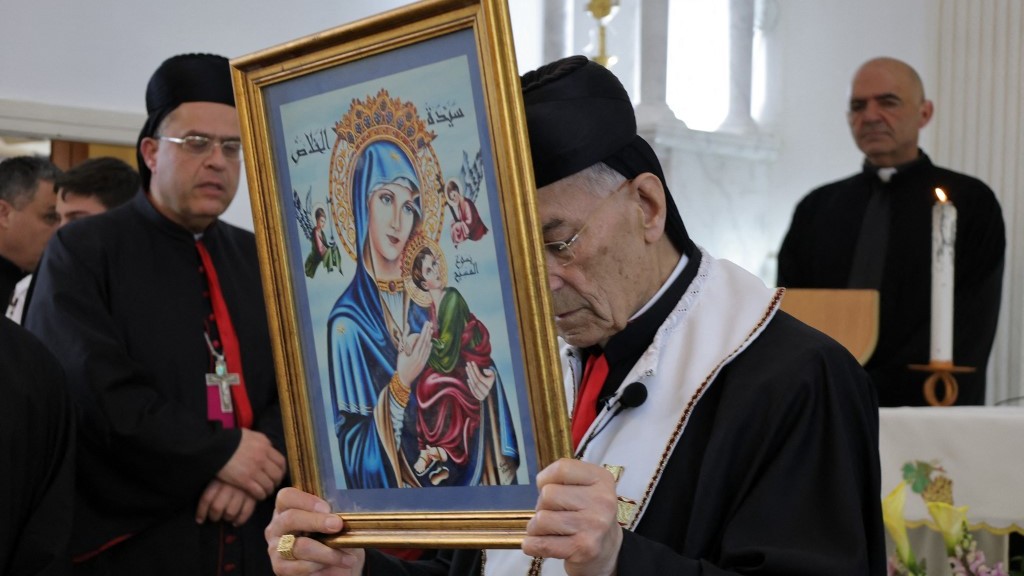
Since October 7, 2023, Israel's war in Gaza has metastasized into a broader campaign against Hezbollah in Lebanon. The stated goal is to dismantle Hezbollah's military infrastructure. The unstated goal appears to be the permanent weakening of Lebanon's Christian communities, communities that have historically served as a buffer between Sunni and Shia forces. Cardinal Bechara al-Rai, the Maronite Patriarch of Antioch, has warned repeatedly that Israel's actions risk turning Lebanon into a "Sunni-Shia battlefield," with Christians caught in the middle. His warnings have gone unheeded. In April 2026, Israeli forces killed at least 2,659 people and wounded 8,183 in Lebanon since March 2, according to Lebanon's National News Agency. Among the dead are not just fighters, but priests, nuns, and civilians who had no role in the conflict. The ceasefire announced on April 17, 2026, has done little to halt the destruction. Israel's military continues to target what it calls "infrastructure," but the list of destroyed sites reads like a roll call of Christian heritage: the Melkite churches in Yaroun and Derdghaya, the convents of the Salvatorian Sisters, and now, the symbolic smashing of religious icons.
This is not the first time Christians in the Levant have faced existential threats. During the 1915 Armenian Genocide, Ottoman forces targeted Christian minorities across Anatolia and Syria. During the Lebanese Civil War, Christian militias and Muslim factions alike committed atrocities. But what is unfolding now is different. It is not a civil war. It is a war by an external power that appears to be systematically dismantling the region's Christian infrastructure. The question is why. Is it a byproduct of Israel's broader military strategy? Or is it a deliberate effort to reshape the demographic and religious map of the Levant?
What Happened: The Convent, the Jackhammer, and the Pattern No One Can Ignore
A Catholic charity, L'Oeuvre d'Orient, confirmed the destruction of the Salvatorian Sisters' convent in Yaroun, southern Lebanon, in early May 2026. According to reporting by Middle East Eye, Israeli troops demolished the building during a military operation. The charity condemned the act as "a deliberate attack on a place of worship," noting that Christian sanctuaries had also been destroyed during the 2024 war. Images circulated in April showed an Israeli soldier using a jackhammer to desecrate a statue of Jesus on a cross in the same region, further fueling outrage. The military's response was typical: it claimed the convent was damaged during operations targeting "infrastructure" in the area. But the evidence suggests otherwise. The destruction was precise. The timing was deliberate. And the pattern is undeniable.
This was not an isolated incident. In occupied East Jerusalem, a nun was assaulted near the Cenacle on Mount Zion in early 2026, sustaining facial injuries. Israeli police also blocked the Latin Patriarch of Jerusalem, Cardinal Pierbattista Pizzaballa, and other clergy from holding Palm Sunday Mass at the Church of the Holy Sepulchre before partially restoring access under international pressure. The Rossing Centre's report documented 155 incidents in 2025, including vandalism, harassment, and physical assaults. These are not random acts of violence. They are part of a coordinated campaign to intimidate and marginalize Christian communities across the region.
The destruction of the Yaroun convent is particularly significant because it is not just a building that has been lost. It is a symbol. Yaroun is a predominantly Christian village near the Israeli border, a place where families have lived for generations. The convent was a center of education, healthcare, and spiritual life. Its destruction sends a message: there is no safe space for Christians in southern Lebanon anymore. And if that message is not challenged, the Levant's Christian communities could disappear entirely.
Global and Regional Reaction: Condemnation, Silence, and the Politics of Persecution
The international response to the destruction of the Yaroun convent has been swift but fragmented. The Vatican issued a statement calling the attack "a grave violation of religious freedom and international humanitarian law." The European Union condemned the destruction of cultural and religious heritage sites, calling it "unacceptable." The United Nations Human Rights Council passed a resolution in April 2026 expressing "deep concern" over the rise in attacks on Christian communities in the region. But these statements have done little to change Israel's calculus. The U.S., Israel's closest ally, has remained largely silent on the issue, focusing instead on the broader ceasefire negotiations and the need to contain Hezbollah.
Regional reactions have been equally tepid. Arab states, including Saudi Arabia and Egypt, have condemned Israel's military actions in Lebanon but have not specifically addressed the targeting of Christian sites. Lebanon's government, already weak and divided, has been unable to protect its Christian minority. Hezbollah, the dominant Shia militia, has framed the conflict as a resistance against Israeli aggression but has not condemned the attacks on Christian communities. This silence is telling. It suggests that the erosion of Christian presence in Lebanon is seen as an inevitable consequence of war, rather than a humanitarian crisis requiring urgent action.
The most vocal condemnation has come from Christian leaders themselves. Cardinal al-Rai has warned that Israel's actions risk turning Lebanon into a "Sunni-Shia battlefield," with Christians as the primary victims. The patriarch has also accused regional powers of complicity, arguing that the international community's silence is enabling the campaign of intimidation. "The world watches as our heritage is erased," he said in a statement to Middle East Eye. "But who will speak for us when we are gone?"
The lack of a unified global response is not surprising. The world is focused on the broader geopolitical stakes of the Israel-Hezbollah war: the risk of regional escalation, the humanitarian catastrophe in Gaza, and the potential for a wider conflict involving Iran. But the destruction of Christian heritage is not a side issue. It is a core component of the crisis. And if it is not addressed, the consequences will reverberate far beyond the Levant.
South Asia Impact: Diaspora Fears, Extremist Narratives, and the Looming Threat to Minority Rights
For South Asia, the fallout from Israel's campaign in Lebanon is already being felt. The region is home to some of the world's oldest Christian communities, with roots stretching back to the apostolic era. In Pakistan, Christians make up just 1.6% of the population but face systemic discrimination, forced conversions, and violent attacks. In India, the Christian minority, 2.3% of the population, has seen a surge in hate crimes under the current government. In Sri Lanka, Easter Sunday bombings in 2019 killed 259 people and left the Christian community traumatized. The destruction of Christian sites in Lebanon is not just a distant tragedy. It is a blueprint for what could happen next.
The parallels to Pakistan's own history are stark. In 2013, a mob attacked a Christian neighborhood in Lahore, burning homes and churches after a blasphemy allegation. In 2020, a Christian man was burned alive by a mob in Punjab over a property dispute. These incidents were not isolated. They were part of a broader pattern of violence that has left Pakistan's Christian minority living in fear. The destruction of the Yaroun convent sends a message to extremists in Pakistan: that the international community will not intervene to protect Christian minorities. It validates the idea that Christians are fair game.
The impact is not just symbolic. The South Asian diaspora is deeply connected to the Levant. Many Pakistani and Indian Christians trace their families back to Lebanon, Syria, and Palestine. The loss of Christian heritage in the Levant is not just a cultural tragedy, it is a personal one for millions of families across South Asia. It also risks fueling extremist narratives. In India, where the ruling Bharatiya Janata Party has promoted a Hindu nationalist agenda, the silence on the attacks in Lebanon could be used to justify further marginalization of Christians. In Pakistan, where blasphemy laws are often weaponized against minorities, the precedent from Lebanon could embolden hardliners to escalate violence.
The GFN editorial desk assesses that the fallout from Israel's campaign in Lebanon will have three immediate effects in South Asia: first, a surge in diaspora activism, with Christian groups in Pakistan and India organizing protests and lobbying governments to condemn the attacks; second, a potential increase in hate crimes against Christians in both countries, as extremists draw inspiration from the perceived impunity in the Levant; and third, a shift in regional diplomacy, with Pakistan and India under pressure to take a stronger stance on minority rights at the United Nations and the Organization of Islamic Cooperation. The question is whether either country will act, or whether they will remain silent, as they have in the past.
What Happens Next: The Unraveling of a Two-Thousand-Year-Old Presence
Analysts expect the campaign against Christian communities in the Levant to intensify in the coming months. Israel's military has shown no sign of halting its operations in southern Lebanon, despite the ceasefire announced in April 2026. The destruction of the Yaroun convent is likely just the beginning. If current trends continue, the next targets could include major Christian pilgrimage sites, such as the Monastery of St. George in Deir Qamar or the Our Lady of Lebanon Basilica in Harissa. The loss of these sites would not only erase physical landmarks but also sever the last ties between the region's Christian communities and their historical roots.
A key question is whether the international community will finally act. The Vatican has called for a UN-led investigation into the attacks on Christian sites, but such a move is unlikely to gain traction in the Security Council, where the U.S. would likely veto any resolution critical of Israel. The European Union has threatened sanctions, but these would be symbolic at best. The most effective pressure may come from South Asian governments, particularly Pakistan and India, which have large Christian minorities and strong diplomatic ties to the Arab world. But so far, both countries have been conspicuously silent. The GFN editorial desk assesses that this silence will not last. As the destruction of Christian heritage becomes impossible to ignore, Islamabad and Delhi will face growing pressure to take a stand.
Another critical factor is the role of Hezbollah and other armed groups in Lebanon. If these groups continue to avoid condemning the attacks on Christian sites, they risk alienating one of their most vulnerable constituencies. Christians in Lebanon have historically been a moderating force, advocating for coexistence between Sunnis and Shias. If they are pushed out, the country's already fragile social fabric could unravel entirely. The fall of the last Christian strongholds in southern Lebanon could trigger a mass exodus, with refugees heading to Europe, the Americas, or even South Asia. The humanitarian consequences would be catastrophic.
For the Christian communities themselves, the future is uncertain. Some may choose to stay and resist, as they have for centuries. Others may flee, joining the millions of Syrians, Iraqis, and Palestinians who have already left the region. But the most likely outcome is a slow, steady decline. The Levant's Christian communities have survived invasions, crusades, and civil wars. But they may not survive indifference. The world is watching. The question is whether it will do more than watch.
Will the World Let the Cradle of Christianity Die?
The destruction of the Yaroun convent is not just a tragedy. It is a test. It is a test of whether the international community still values the preservation of cultural and religious heritage. It is a test of whether South Asian governments will stand up for their Christian minorities in the face of rising extremism. And it is a test of whether the world is willing to let the cradle of Christianity die.
The signs are not encouraging. The U.S. has remained silent. The EU has issued statements. The Arab world has looked the other way. And in South Asia, the response has been muted at best. But history teaches that when one minority is targeted, others are not far behind. The erasure of Christianity in the Levant will not stop at Lebanon's borders. It will reverberate across the region, emboldening extremists and normalizing persecution. For South Asia's 30 million Christians, the stakes could not be higher. The question is whether anyone will act before it is too late.
Related Coverage
Middle East Conflict Analysis → — In-depth analysis, background context, and continuous updates on this developing story.
Key Takeaways
- Israel's deliberate destruction of a Christian convent in Yaroun is part of a broader campaign to erase Christianity from the Levant, with at least 155 documented attacks on Christian sites and clergy in 2025 alone.
- GFN Editorial: For South Asia, the fallout risks normalizing the idea that Christian minorities are expendable, potentially emboldening extremists in Pakistan and India to escalate violence against local Christian communities.
- The international community's muted response suggests that the erasure of Christian heritage in the Levant may be treated as an inevitable consequence of war rather than a humanitarian crisis requiring urgent action.