The same knife that slashed at two Jewish men in London on 29 April had already pierced the door of a Muslim man hours earlier. Yet when Keir Starmer's government rushed to brand pro-Palestine marches as the engine of antisemitic violence, it erased the Muslim victim from the story entirely. In doing so, it did not merely misdiagnose a crisis; it weaponised one.
Why Britain's Protest Scapegoating Threatens More Than Free Speech
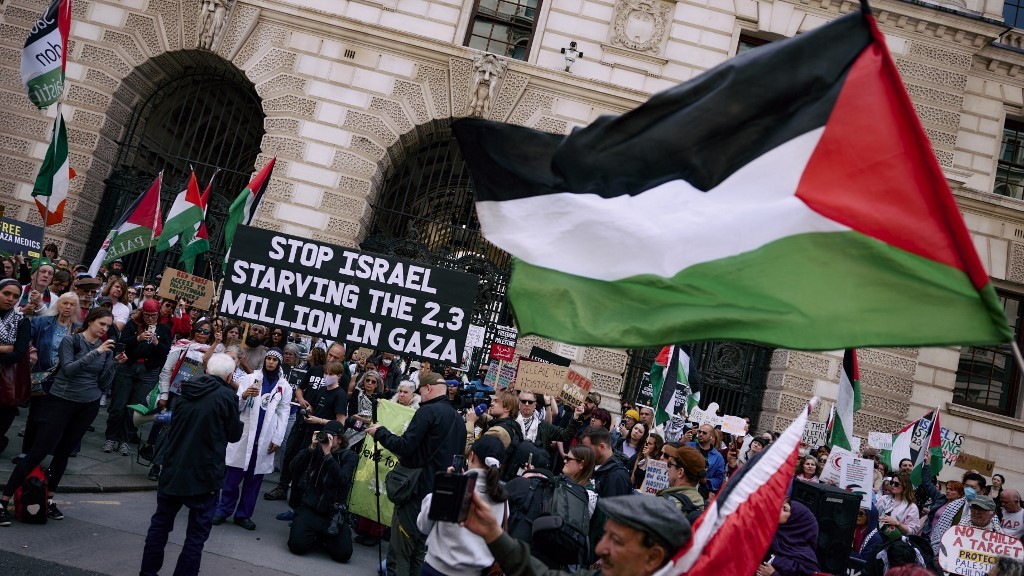
What began as a domestic spat over policing and identity has metastasised into a template for how liberal democracies can criminalise dissent while claiming to protect minorities. The Starmer administration's insistence that "pro-Palestine protests fuel antisemitism" is not an error of emphasis; it is a strategic shift. By collapsing the distinction between criticism of Israel and hatred of Jews, the government can now justify bans on marches, deploy surveillance on organisers, and recast civil disobedience as a public-order threat. The stakes are global because the tactic is portable. If London can brand Gaza solidarity as inherently dangerous, Islamabad, Delhi, and Dhaka will face the same rhetorical arsenal when their streets fill with protesters over Kashmir, Palestine, or Myanmar. The real question is not whether antisemitism is rising, but whether governments will exploit that rise to shrink the space for Muslim political expression.
A Brief History of How Dissent Becomes Dangerous
This is not Britain's first rodeo in weaponising "community safety" against protest. In 2019, during the final months of Theresa May's premiership, the Home Office circulated a Prevent Duty guidance that explicitly warned schools and universities about "extremist" materials in Palestine solidarity campaigns. The guidance cited cartoons and chants that criticised Israeli policy, not antisemitic tropes. The result? Dozens of student societies were investigated, and several mosques were placed under covert surveillance. The pattern is clear: whenever Muslim political agency grows, whether in the form of Palestine marches, halal food boycotts, or even mosque attendance, the state rebrands the phenomenon as a security risk. The 2019 episode set the precedent; the 29 April double attack has given Starmer the political cover to escalate it.
Across South Asia, the echoes are unmistakable. In 2021, after Pakistan's Supreme Court upheld the acquittal of Asia Bibi, a Christian woman accused of blasphemy, Islamabad faced a wave of Islamist mobilisation. The government responded not by addressing the blasphemy law itself, but by banning dozens of religious parties and deploying cybercrime units against organisers. The message was identical to London's today: dissent is the threat, not the context in which violence occurs. The difference is that in Pakistan, the tactic was justified by national security; in Britain, it is justified by "safeguarding" Jews. The mechanism is the same.
Who Is Doing the Scapegoating, and How They Do It
According to reporting by Middle East Eye, the Muslim Council of Britain (MCB), the UK's largest Muslim umbrella body, has accused the Starmer government of promoting "inaccurate and counterproductive" narratives that link pro-Palestine marches to antisemitic violence. The MCB statement, released on 2 May 2026, did not mince words: it condemned the stabbing of two Jewish men in northwest London while simultaneously noting that the suspect had also targeted a Muslim man, Ishmail Hussein, in Southwark the same morning. The MCB's point was not to exonerate the attacker, he faces three counts of attempted murder, but to expose the selective outrage of a state that weaponises one victim's pain to silence an entire community's politics. The MCB's critique is not isolated. The Muslim Association of Britain (MAB) went further, arguing that the attack was being "used to prosecute a case already prepared, against Muslim communities, against Palestinian solidarity, against the right to dissent."
On the political side, Birmingham MP Ayoub Khan and journalist Owen Jones both highlighted the media's erasure of Hussein's ordeal. Khan wrote on X that "three charges of attempted murder" had been filed, yet coverage fixated on the Jewish victims alone. Jones asked a sharper question: "What is the editorial justification for not even stating that it's three counts of attempted murder?" The implication is chilling: when a suspect's victims include both Jews and Muslims, the narrative is curated to serve a political end, not to reflect the full truth.
London's Double Attack: What Actually Happened
On 29 April 2026, a man discharged earlier that day from a psychiatric unit in London attacked two Jewish men in a northwest London neighbourhood with a large Jewish population. The suspect, whose identity has not been made public, was charged with three counts of attempted murder. According to Middle East Eye, the same individual had also targeted Ishmail Hussein, a Muslim man, at his home in Southwark earlier that morning. The MCB's statement confirmed that Hussein was stabbed at his residence before the suspect moved to northwest London. The Metropolitan Police have not released a motive, but the timeline suggests a single perpetrator acting within hours across two boroughs. Meanwhile, Prime Minister Keir Starmer, in remarks covered by British media, explicitly conflated the incident with pro-Palestine protests, stating that "the rise in antisemitism cannot be separated from the toxic atmosphere created by marches that demonise Israel." The MCB rejected this linkage outright, calling it "inaccurate and counterproductive."
Global Condemnation, and Selective Silence
The United Nations Special Rapporteur on freedom of religion or belief, Ahmed Shaheed, issued a statement on 3 May 2026 expressing "grave concern" over the UK government's rhetoric, warning that it risked "normalising the conflation of legitimate political expression with hate speech." The European Union's Fundamental Rights Agency echoed the concern, noting in its weekly bulletin that "any policy that treats all criticism of Israel as inherently antisemitic sets a dangerous precedent for pluralistic democracies."
In contrast, the US State Department, while calling for calm, avoided criticising Starmer's framing, instead urging "all communities to come together." The silence from Washington is telling: the Biden administration has itself faced criticism for conflating campus protests with antisemitism, most notably during the 2024 Columbia University encampments. Meanwhile, Israel's Ministry of Foreign Affairs issued a statement thanking the UK for its "firm stance against antisemitism," without acknowledging the MCB's call to address Islamophobia with equal vigour. The pattern is consistent: Western governments condemn antisemitism when it serves their domestic narratives but remain conspicuously silent when Muslim victims are erased from the same story.
South Asia's Stake: When Dissent Becomes a Security Threat
GFN Ground Context: In 2020, Pakistan's Interior Ministry banned the Tehreek-e-Labbaik Pakistan (TLP) under anti-terrorism laws after the party organised nationwide protests against France over blasphemous cartoons. The ban was justified as a counter-extremism measure, yet the TLP's core demand, expelling the French ambassador, was a political stance, not an incitement to violence. The pattern mirrors London's today: a government uses a security pretext to criminalise dissent, while the actual perpetrators of violence (in Pakistan's case, TLP activists who clashed with police) are treated as collateral damage in a larger narrative. The UK's current trajectory suggests that Islamabad may soon face the same dilemma: clamp down on Muslim political expression under the banner of "safeguarding" Jews or Christians, or risk being outflanked by hardliners who accuse the state of betraying the ummah.
What Happens Next: Three Possible Paths
Analysts expect the Starmer government to double down on its protest-ban agenda. The most likely outcome is that the Home Office will publish a new "hate crime" guidance by summer 2026 that explicitly links Palestine solidarity chants to antisemitic incidents, even when no direct evidence exists. This would allow police to disperse marches preemptively, citing "public order" concerns. The MCB has already signalled it will challenge any such guidance in court, setting up a constitutional clash over free assembly.
A second possibility is that the government will pivot to a "both sides" narrative, acknowledging Islamophobia while still framing pro-Palestine protests as a driver of antisemitism. This would allow Starmer to mollify Muslim voters without conceding the central premise of his crackdown. The risk is that Muslim communities, already alienated by Labour's stance, will see the move as cosmetic and withdraw further from electoral politics.
The third scenario, currently the least likely, is that the Metropolitan Police will release detailed forensic evidence showing that the 29 April attacker acted alone and was not motivated by either Palestine activism or antisemitism. If such evidence emerges, it could force Starmer to walk back his rhetoric. But given the political capital already invested in the "protest-antisemitism" narrative, analysts expect the government to treat any such evidence as an inconvenience rather than a correction.
Could This Spread to South Asia?
The UK's protest-scapegoating model is already being tested in India. In 2025, the Modi government invoked "public order" clauses to ban over a dozen solidarity marches for Palestine in Kashmir and Delhi, citing "potential for communal violence." The justification mirrored London's: pro-Palestine protests, even peaceful ones, were framed as inherently risky. In Bangladesh, the Awami League has used similar rhetoric to justify raids on madrasas and student unions, arguing that "Islamist extremism" thrives in spaces that host Palestine solidarity events. The difference is that in South Asia, the tactic is justified by counterterrorism; in Britain, it is justified by "safeguarding" Jews. The mechanism is identical: dissent is rebranded as danger.
The real danger for South Asia is not that London's tactics will be imported wholesale, but that they will be repackaged as "best practice." If Starmer can ban Palestine marches by citing antisemitism, Delhi can ban Kashmir marches by citing "national integrity," and Dhaka can ban Rohingya solidarity events by citing "social cohesion." The UK's current crisis is a laboratory for how liberal democracies can dismantle civic freedoms under the banner of minority protection.
What Should South Asian Readers Watch For
The most immediate red flag will be any new UK guidance that equates pro-Palestine chants with antisemitic hate speech. If London moves to ban specific slogans, such as "From the river to the sea", it will set a precedent that Islamabad, Delhi, and Dhaka can cite in their own crackdowns. Another indicator will be the tone of Muslim political parties in Pakistan during the upcoming 2026 by-elections. If the TLP or Jamaat-e-Islami (JI) are banned or their leaders arrested under "hate speech" laws, it will confirm that the UK model is being adopted locally. Finally, watch for statements from the Organisation of Islamic Cooperation (OIC). If the OIC issues a strong rebuke to the UK's protest-scapegoating, it could galvanise Muslim-majority states to resist importing the tactic. But if the OIC remains muted, it will signal that the narrative has global traction.
Related Coverage
Middle East Conflict Analysis → — In-depth analysis, background context, and continuous updates on this developing story.
Key Takeaways
- London's protest-scapegoating is not about antisemitism; it is about criminalising Muslim political agency. The MCB's warning that the government is "prosecuting a case already prepared" reveals a premeditated assault on dissent, not a response to violence.
- The 29 April double attack was used as political cover to erase a Muslim victim and justify protest bans. The suspect's third victim, Ishmail Hussein, was ignored by media and politicians alike, exposing a selective outrage that serves a narrative.
- South Asia's democracies are already testing the UK model, and Islamabad faces a choice: resist the template or import it. The 2020 ban on the TLP in Pakistan set a precedent that London is now perfecting; the question is whether Islamabad will learn from the UK's mistakes or repeat them.