When the Karakoram Highway creaks back to life after another landslide, the relief is always temporary. This weekend, the Pakistan Meteorological Department (PMD) sounded the alarm: an approaching westerly weather system could turn dozens of glacial lakes into ticking time bombs across Gilgit-Baltistan and Khyber Pakhtunkhwa. The blocked roads, KKH and Astore valley, are mere symptoms of a deeper fragility. Behind the debris lies a question Pakistan can no longer afford to ignore: what happens when the glaciers that feed the Indus stop storing water and start releasing it all at once?
Why the Himalayan Thaw Could Unravel Pakistan's Fragile North
Glacial lake outburst floods (Glofs) are not a distant threat; they are a creeping emergency. Pakistan is home to over 13,000 glaciers, the largest concentration outside the polar regions, and they are melting faster than any other in the Himalayas. The PMD's latest alert warns that a moderate westerly wave, expected to enter upper Pakistan from Sunday, could push temperatures up, destabilize ice dams, and release millions of cubic meters of water in minutes. The Ministry of Climate Change estimates that more than 7.1 million people in Gilgit-Baltistan and Khyber Pakhtunkhwa are vulnerable. But the real danger extends far beyond the mountains. The Indus River system, which irrigates 90% of Pakistan's farmland, is fed by glacier melt. If Glofs begin to occur with seasonal regularity, they won't just destroy villages, they could disrupt the entire agricultural calendar downstream, trigger power shortages, and force mass displacement. And all of this is unfolding against the backdrop of a national economy already reeling from inflation, energy deficits, and climate-induced crop failures. The question isn't whether a Glof will happen this year. It's whether Pakistan is prepared for a decade of them.
The Growing Shadow of Glofs: A Timeline of Himalayan Risk
The first recorded Glof in Pakistan's modern history struck the Hunza valley in 1986, when the Khyber Pass-like Khurdopin glacier dam burst, releasing a wall of water that swept away bridges, crops, and entire hamlets. Since then, the frequency has risen sharply. In 2010, the Attabad landslide blocked the Hunza River, creating a 12-kilometre lake that displaced 20,000 people and cut off the KKH for two years. But the turning point came in 2019, when a series of Glofs in Chitral and Gilgit-Baltistan killed at least 12 people and destroyed hundreds of homes. That same year, the government established the National Emergencies Operation Centre (NEOC) under the National Disaster Management Authority (NDMA), tasking it with issuing seasonal Glof advisories. The NEOC's February 2026 warning, issued just months before this weekend's alert, was unusually explicit: elevated Glof risks between March and September 2026 due to rising temperatures and erratic monsoon patterns. This wasn't a routine notice. It was a recognition that Pakistan's glaciers, once seen as eternal reservoirs, are now becoming unpredictable hazards. The Astore valley road, blocked again this weekend, is only the latest casualty of a region caught between melting ice and monsoon unpredictability. The pattern is clear: each passing year brings more rain, more landslides, and more glacial instability. The last time the upper Indus basin faced a comparable cascade of risks was during the 2010 floods, which submerged a fifth of Pakistan and displaced 20 million people. But today, the stakes are higher. Pakistan's population has grown by 30 million since then, and its water infrastructure is more stressed than ever. The 2010 floods exposed the fragility of the Indus River System Authority (IRSA) and the weak coordination between provincial disaster management authorities. The lessons were never fully institutionalized. Now, as the PMD warns of another westerly wave, the country risks repeating the same mistakes under even greater pressure.
What Happened: Roads, Rain, and the Looming Glof Threat
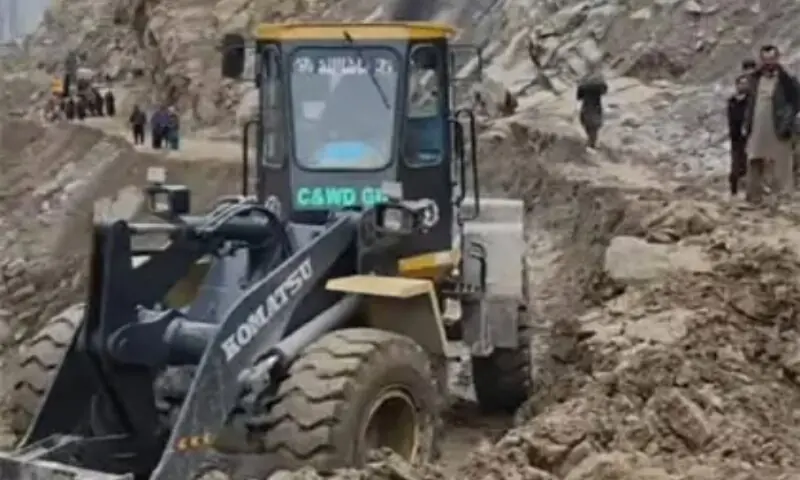
On Friday and Saturday, intermittent rain across Gilgit-Baltistan triggered landslides that blocked the Karakoram Highway (KKH) near Hunza's Murtazabad area and the Astore valley road at multiple points, according to reporting by Dawn News. Traffic was restored after debris clearance, but the reprieve was brief. The real concern lay upstream. The Pakistan Meteorological Department (PMD) issued a fresh alert warning that a moderate westerly weather system would enter the upper parts of the country from Sunday, bringing widespread rain, wind, and thunderstorms across Gilgit-Baltistan and Khyber Pakhtunkhwa. The Met Office cautioned that a sudden rise in temperatures followed by precipitation "significantly elevates" the risk of Glofs, debris flow, and flash flooding in vulnerable areas, including Hoper, Ghulkin, Shishper, Yasin, Phander, Badswat, lower Hunza, Nagar, Ghanche, Shigar, Swat, upper Chitral, Dir, and Astore. Residents were advised to avoid riverbanks, move livestock to higher ground, and monitor local nullahs for sudden changes in water colour or unusual sounds, classic precursors to debris flows. The NDMA's Community-Based Disaster Risk Management Committees were put on high alert, tasked with coordinating evacuations and disseminating SMS alerts. This is not the first time such warnings have been issued. Last summer, rapidly melting glaciers, Glofs, and cloudbursts caused significant damage in Gilgit-Baltistan, according to Dawn News. But this weekend's alert carries added weight. It comes after the NEOC's February advisory, which flagged elevated risks between March and September 2026. The convergence of seasonal heat, monsoon unpredictability, and glacial instability has created a perfect storm, one that Pakistan's disaster management system is still struggling to weather.
Global and Regional Reaction: From Geneva to Islamabad
International climate agencies have been watching Pakistan's glacial crisis for years. The United Nations Office for Disaster Risk Reduction (UNDRR) has repeatedly flagged Pakistan as one of the most vulnerable countries to climate-induced disasters, with Glofs and flash floods ranking among the top threats. In 2022, the UN's Intergovernmental Panel on Climate Change (IPCC) warned that Himalayan glaciers could lose up to 80% of their volume by 2100 if global warming continues unchecked. Pakistan, sitting at the downstream end of the Hindu Kush Himalaya (HKH) region, is on the frontline. China, which shares several glacier-fed river basins with Pakistan, has not publicly commented on this weekend's Glof alert. But Beijing's own glacial monitoring in the Karakoram and Tien Shan ranges suggests it is acutely aware of the risks. In 2023, Chinese state media reported that melting glaciers in the Shaksgam Valley, claimed by both countries, had created new glacial lakes, raising concerns about transboundary Glof risks. India, meanwhile, has been monitoring glacial stability in the upper Indus basin as part of its broader Himalayan security assessments. New Delhi has raised the issue in bilateral talks with Islamabad, particularly in the context of the Indus Waters Treaty, though no public statements have been issued in response to this weekend's alert. Within Pakistan, the response has been fragmented. The Climate Change Ministry has urged residents to share alerts via SMS and social media, while the NDMA has directed provincial authorities to maintain communication with technical focal persons in remote valleys. But critics argue that Pakistan's disaster management system remains under-resourced and poorly coordinated. The 2020 establishment of the National Adaptation Plan (NAP) was a step forward, but implementation has lagged. Provincial governments in Gilgit-Baltistan and Khyber Pakhtunkhwa bear the brunt of the response, yet they lack the technical capacity to monitor glacial lakes in real time. The PMD's Glof alerts are based on satellite data and weather models, but there is no dedicated glacial lake monitoring network on the ground. The result is a system that can warn of danger but cannot always prevent it.
GFN Editorial: For South Asian readers, the PMD's Glof alert is a reminder that climate change is not a future threat, it is a present crisis reshaping the Himalayas. Pakistan's glaciers are not just melting; they are becoming weapons of mass disruption. The blocked KKH and Astore valley roads are early casualties, but the real battle is for the Indus. If Glofs begin to disrupt the river's flow, Pakistan's food security, energy grid, and internal stability could unravel faster than its disaster response can recover. The question for Islamabad is not whether to prepare, but how. Can the NDMA's early warning systems scale up before the next westerly wave? Can the provinces afford the infrastructure upgrades needed to monitor glacial lakes in real time? And can Pakistan afford to wait for the next disaster to act?
South Asia Impact: When the Himalayas Turn Against Their Neighbors
For Pakistan, the immediate impact of Glof risks is clear: blocked roads, destroyed bridges, and displaced communities. But the long-term consequences could be existential. The Indus River System Authority (IRSA) manages water flows between provinces, but it was designed for predictable glacial melt, not for sudden, catastrophic releases. A major Glof in the upper Indus basin could overwhelm dams, breach irrigation canals, and contaminate drinking water with sediment. The Tarbela and Mangla reservoirs, already silted up and operating at reduced capacity, would face unprecedented pressure. Energy shortages would follow, as hydropower plants struggle with erratic flows. Agriculture, which consumes 94% of Pakistan's water, would bear the brunt. The Indus basin supports 200 million people and 40% of the country's GDP. A disruption in water supply could trigger food price spikes, rural unrest, and mass migration toward cities already straining under climate refugees. The 2010 floods showed how quickly Pakistan's social fabric can fray when water systems fail. The 2026 Glof alert suggests that failure could become routine. For India, the risks are transboundary. The upper Indus basin feeds both Pakistan and India, and a Glof in Pakistani territory could send debris and contaminated water downstream into Indian-administered Kashmir. While no major incidents have been reported, Indian officials have privately expressed concern about the lack of real-time glacial monitoring in Gilgit-Baltistan. For China, the risks are more immediate. The Shaksgam Valley, where Chinese and Pakistani glaciers converge, has seen accelerated melting, creating new glacial lakes that could burst without warning. A Glof there could send debris into the Hunza River, affecting both countries. The China-Pakistan Economic Corridor (CPEC) routes, which run through Gilgit-Baltistan, are particularly vulnerable. A major landslide or flood could sever critical supply lines, disrupting Chinese investments and Pakistani trade. The 2019 collapse of the KKH near Hasan Abdal, which cut off CPEC's western route for months, was a taste of what's to come. The Astore valley road, blocked again this weekend, is a microcosm of the broader challenge: Pakistan's infrastructure was built for a stable climate. It is now facing a climate in flux. The GFN editorial desk notes that the real question for Islamabad is whether it can pivot from reactive disaster management to proactive glacial risk reduction, before the next westerly wave turns the Himalayas into a threat rather than a lifeline.
What Happens Next: From Alerts to Adaptation
Analysts expect the next 72 hours to be critical. The westerly wave is due to arrive by Sunday, and the PMD's models suggest temperatures in Gilgit-Baltistan could spike by 5-7°C within 48 hours. That sudden warmth, combined with heavy rainfall, could destabilize ice dams in glacial lakes such as Shishper and Khurdopin, both of which have grown significantly in recent years. The NDMA has directed provincial authorities to evacuate communities in high-risk zones, but the scale of the operation is daunting. Gilgit-Baltistan's population is scattered across remote valleys, many accessible only by narrow roads. The last major Glof in 2019 displaced 5,000 people in Chitral alone, and recovery took years. This time, the stakes are higher. The most likely outcome is a series of localized but severe Glofs, particularly in the Hunza, Nagar, and Astore valleys. These events will likely trigger landslides, block roads, and damage irrigation systems, but they may not reach the catastrophic scale of the 2010 floods. However, the cumulative impact of repeated Glofs could be just as damaging. Each event will erode trust in Pakistan's disaster response, strain provincial budgets, and deepen public frustration with climate inaction. A key question is whether the federal government will finally invest in a national glacial lake monitoring system. Currently, Pakistan relies on satellite data from international agencies like NASA and the European Space Agency. While useful, these systems lack the resolution to predict Glofs in real time. The NDMA has proposed a network of automated weather stations and river gauges in glacial valleys, but funding remains uncertain. Another critical issue is the lack of coordination between Pakistan and its neighbors. India and China both monitor glacial stability in the Himalayas, but there is no formal mechanism for sharing data or issuing joint warnings. The Indus Waters Treaty, which governs water sharing between Pakistan and India, does not address Glof risks. A transboundary Glof could become a flashpoint, particularly if debris flows contaminate water supplies downstream. For Pakistan, the path forward is clear but difficult. It must upgrade its disaster infrastructure, invest in glacial monitoring, and prepare for a future where the Himalayas are no longer a source of life but a source of danger. The alternative is a slow-motion crisis, one where each westerly wave brings not just rain, but ruin.
Related Coverage
Global Economy Analysis → — In-depth analysis, background context, and continuous updates on this developing story.
Key Takeaways
- Pakistan's latest Glof alert, triggered by an approaching westerly wave, signals a shift from glacial melt to glacial hazard, with 7.1 million people in Gilgit-Baltistan and Khyber Pakhtunkhwa at risk.
- The blocked Karakoram Highway and Astore valley road are symptoms of a deeper fragility: Pakistan's infrastructure and water systems were built for a stable climate, not for the erratic glacial behavior of 2026.
- The real test for Islamabad is not just disaster response, but long-term adaptation, including a national glacial monitoring network and transboundary coordination with India and China to prevent future Himalayan disasters.