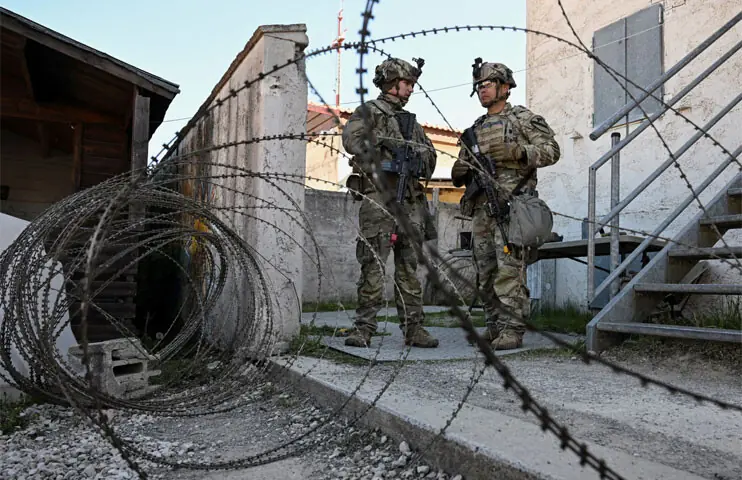
When Donald Trump calls for fewer American boots on European soil, the message is rarely just about numbers. It is about burden-sharing, about alliances, and about whether Washington still sees its security guarantees as automatic. On Friday, the Pentagon confirmed the withdrawal of 5,000 US troops from Germany, one of the largest overseas concentrations of American forces, and dropped plans to station a long-range Tomahawk missile battalion there. Berlin's reaction was muted but pointed: Europe must do more for itself. Yet behind the diplomatic phrasing lies a deeper anxiety. If the United States is willing to shrink its forward presence in the heart of NATO, what does that mean for the alliance's cohesion, and for partners beyond Europe who have long relied on Washington's word?
Why this withdrawal could unravel NATO's fragile unity
At first glance, 5,000 troops out of nearly 40,000 stationed in Germany may seem like a drop in the ocean. But strategically, it is not. The move comes as NATO scrambles to deter a resurgent Russia in Eastern Europe, where Poland and the Baltics already feel exposed. The cancellation of the Tomahawk battalion, meant to give Germany a rapid-strike capability against distant targets, further weakens the alliance's deterrent posture. As Senator Roger Wicker and Representative Mike Rogers, the top Republican defense leaders in the US Congress, warned in a joint statement, prematurely reducing America's forward presence risks undermining deterrence and sending the wrong signal to Vladimir Putin. Their concern is not just about the troops themselves, but about the precedent: if Washington walks away from Germany, can it be trusted to stay in Poland, Romania, or the Black Sea?
This is not the first time Trump has threatened to shrink the US footprint in Europe. During his first term, he openly questioned NATO's value and pressured allies to increase defense spending. But this latest move arrives amid fresh transatlantic rifts, over the Iran war, over tariffs, and over Washington's exit strategy in the Middle East. German Chancellor Friedrich Merz has publicly questioned US policy in the region, and Trump's response has been to tighten the screws. The message is clear: Europe, take care of your own defense. Yet the irony is that Europe is already trying. Germany has pledged to spend 2% of GDP on defense, has fast-tracked military procurement, and is building new infrastructure for NATO reinforcements. The problem is that these steps take time, and deterrence cannot wait. As Polish Prime Minister Donald Tusk wrote on X, the greatest threat to the transatlantic community are not its external enemies, but the ongoing disintegration of our alliance. His warning is not hyperbole. NATO's credibility is built on the belief that Article 5, collective defense, is more than a piece of paper. If Washington begins to act as if it is optional, the alliance's foundations start to crack.
The historical echo: When America turned inward and Europe paid the price
This is not the first moment in modern history when US leadership in Europe has wavered. In the late 1970s, after the Vietnam War and the Watergate scandal, America's global role was questioned at home and abroad. President Jimmy Carter's administration faced pressure to reduce overseas commitments, and Europe worried about a US retreat. The result was a period of drift, until the Soviet invasion of Afghanistan in 1979 forced Washington back into the fold. But the lesson of that era is that retrenchment, even temporary, breeds uncertainty. Allies begin hedging. Russia probes for weakness. And when the US finally re-engages, it does so from a position of diminished influence.
There is a more recent parallel closer to home. In 2020, as the US grappled with the fallout of the Afghanistan withdrawal and domestic polarization, European capitals watched nervously. France and Germany pushed for greater strategic autonomy, but found themselves divided over how far to go. The Trump administration's transactional approach to alliances, demanding more in exchange for less, left many in Europe feeling that Washington's commitment was conditional. Now, with Trump back in the White House and a new troop withdrawal on the table, the cycle risks repeating. The difference this time is that Russia is no longer a declining power. It is an aggressor in Ukraine, a disruptor in the Balkans, and a growing military presence in the Arctic. A US drawdown in Germany does not just weaken NATO's eastern flank, it invites miscalculation in Moscow.
But there is another historical layer to consider: the 1990s, after the Cold War ended. The US maintained a large troop presence in Germany as a stabilizing force, even as Europe sought to define its own security architecture. When Washington began to shift focus to the Middle East and Asia in the 2000s, Europe was left to manage its own crises, from the Balkans to Libya, with mixed results. The lesson? When America steps back, Europe either steps up or steps apart. The current moment suggests the latter is more likely. Germany's defense minister, Boris Pistorius, insists Berlin is on the right track. But the truth is that no European country, even Germany, can replace the deterrent value of 5,000 US troops and long-range missiles on its soil, not quickly, and not without risk.
What happened: The Pentagon's decision, the political backlash, and NATO's response
On Friday, the Pentagon announced the withdrawal of 5,000 US troops from Germany, the largest American base in Europe. The move affects a force of nearly 40,000 soldiers currently stationed in the country. Alongside the troop reduction, the Pentagon also scrapped a Biden-era plan to deploy a long-range Tomahawk missile battalion to Germany, a decision that removes a key element of NATO's deterrent against Russia. According to reporting by Dawn News, German Defence Minister Boris Pistorius responded by saying the withdrawal was expected and that Europe must take more responsibility for its own security. Germany is on the right track, he said, pointing to recent efforts to expand the armed forces, speed up military procurement, and build infrastructure.
But the move has drawn sharp criticism from two top US Republican lawmakers. Senator Roger Wicker and Representative Mike Rogers, chairs of the Senate and House Armed Services Committees, issued a joint statement expressing very concerned over the decision. They argued that the troops should not be moved from Europe entirely, but rather repositioned eastward, closer to Russia's border. Prematurely reducing America's forward presence in Europe before those capabilities are fully realized risks undermining deterrence and sending the wrong signal to Vladimir Putin, they said. Their warning underscores a growing divide within the US political establishment over America's role in Europe.
NATO, meanwhile, has sought to downplay the significance of the decision. A spokesperson for the alliance said NATO is working with the US to understand the details of the plan. But the alliance's ability to project unity is already strained. Poland's prime minister, Donald Tusk, took to social media to warn that the greatest threat to the transatlantic community are not its external enemies, but the ongoing disintegration of our alliance. His words reflect a broader anxiety: if the US begins to treat its European commitments as negotiable, what happens to the security guarantees that have underpinned global stability since 1945?
Global and regional reaction: From Washington to Warsaw, the fault lines appear
In Washington, the troop withdrawal has become yet another flashpoint in the already fraught relationship between the US and Europe. The decision comes at a time of heightened tensions over Iran, tariffs, and the Middle East, where German Chancellor Friedrich Merz has publicly questioned Washington's exit strategy. Trump's response has been to double down on the message that Europe must do more for itself. But his approach is not universally supported, even within his own party. Wicker and Rogers represent a faction of Republicans who still believe in the value of America's forward presence in Europe, particularly as Russia's war in Ukraine grinds on.
In Europe, the reaction has been more measured but no less concerned. Germany's government has emphasized that it is increasing defense spending and modernizing its military. But the cancellation of the Tomahawk battalion is a setback for Berlin, which had pushed for the deployment as a way to bolster deterrence against Russia. France, meanwhile, has long advocated for European strategic autonomy, but its ability to fill the gap left by the US is limited. President Emmanuel Macron has called for a stronger European defense policy, but without American leadership, such efforts risk being fragmented and under-resourced.
In Eastern Europe, the reaction has been the most urgent. Poland, which sits on NATO's eastern flank and faces direct threats from Russia, has been a vocal advocate for a continued US presence. Prime Minister Tusk's warning on social media was not just rhetorical; it was a call to action. His message was clear: if the US retreats, Europe must not. But the reality is that Europe's ability to deter Russia without American support is untested. The Baltics, Romania, and other frontline states are already on high alert. A US withdrawal from Germany, even a partial one, could embolden Moscow to probe NATO's resolve further.
Beyond Europe, the implications are harder to ignore. In the Indo-Pacific, where the US is already stretched thin, a retrenchment in Europe could signal a broader shift in Washington's priorities. Allies in Asia, from Japan to Australia, may begin to question whether the US is still willing to underwrite global security. In the Middle East, where the US has been reducing its footprint, the message is the same: take care of your own security. The problem is that in many of these regions, there is no clear successor to American leadership. The result is a world where deterrence gaps emerge, and miscalculation becomes more likely.
South Asia impact: What a US troop cut in Germany means for Islamabad and beyond
For South Asia, the immediate question is not whether the US will reduce its presence in Germany, but what this signals about Washington's long-term commitment to global security. If the US is willing to shrink its footprint in the heart of NATO, where does that leave partners who have relied on American guarantees for decades? Pakistan, in particular, has watched US policy in the region with growing unease. The US has long been a key player in South Asia, but its focus has shifted, first to the Middle East, then to Asia, and now, potentially, back toward Europe. The question for Islamabad is whether this shift is temporary or the beginning of a longer retreat.
There is a historical parallel here that should worry Pakistani strategists. In 2011, after the US raid that killed Osama bin Laden in Abbottabad, relations between Washington and Islamabad hit a historic low. The US suspended military aid, cut back on counterterrorism cooperation, and began to rethink its role in the region. Pakistan, which had long relied on American support, found itself isolated. The result was a period of drift, one that only ended when the US realized it still needed Pakistan's help in Afghanistan. But by then, trust had eroded, and options had narrowed. Today, with the US once again questioning its global commitments, Pakistan faces a similar dilemma: Can it afford to rely on Washington, or must it hedge its bets?
There is also the question of China's role in the region. Beijing has been steadily expanding its influence in South Asia, from Pakistan's Gwadar port to Sri Lanka's Hambantota. If the US reduces its presence in Europe and the Middle East, it may find itself even more stretched in Asia. That could create opportunities for China to fill the void, but at what cost? For Pakistan, closer ties with Beijing are a strategic necessity, but they come with economic and political strings attached. The US troop cut in Germany may seem distant, but its ripple effects could reach Islamabad faster than anyone expects.
The final implication for South Asia is the most immediate: the potential for a power vacuum. If the US is no longer willing to underwrite European security, it may also be less willing to underwrite security in other regions. That could embolden adversaries like Russia or Iran to test red lines in the Middle East, or even in South Asia. For Pakistan, which sits at the crossroads of Central and South Asia, the stakes could not be higher. The US withdrawal from Germany is a warning shot. The real question is whether Islamabad will heed it, and act before the window closes.
What happens next: A world where deterrence is no longer automatic
Analysts expect the US troop withdrawal from Germany to proceed in phases over the next 12 to 18 months, with the first units redeployed to other European bases or returned to the US. The cancellation of the Tomahawk battalion is likely to stand, as it is tied to broader budget decisions rather than operational needs. But the political fallout will be more enduring. In Washington, the debate over America's role in Europe is far from over. The Republican-led Congress may push back against the withdrawal, either through legislation or funding restrictions. The White House, for its part, will likely frame the move as a necessary step to rebalance global commitments, a message that resonates with Trump's base but alarms allies.
The most likely outcome is a NATO that is more divided than before. Eastern European members, already anxious about US support, will double down on their own deterrence efforts. Poland, for example, has been expanding its military and investing in missile defense. But without American long-range capabilities, these efforts will only go so far. Meanwhile, Western European countries like Germany and France will face pressure to accelerate their own defense initiatives. The problem is that Europe's defense industry is fragmented, and its procurement processes are slow. By the time Europe is ready to fill the gap left by the US, Russia may have already exploited the deterrence vacuum.
A key question is whether the troop withdrawal will accelerate Europe's push for strategic autonomy, or whether it will deepen divisions within the EU. France and Germany have long advocated for a stronger European defense policy, but smaller countries like Poland and the Baltics remain skeptical. They fear that a European-only security architecture will leave them exposed to Russian aggression. If the US continues to reduce its presence in Europe, these tensions will only grow. The result could be a NATO that is less cohesive, less effective, and less able to deter aggression.Beyond Europe, the implications are even more uncertain. In the Indo-Pacific, the US is already struggling to balance its commitments to Japan, South Korea, and Australia with its focus on China. A retrenchment in Europe could force Washington to make even harder choices about where to allocate its resources. Allies in Asia may begin to question whether the US is still willing to underwrite their security, or whether they must prepare for a world where American guarantees are no longer automatic. The same logic applies to South Asia. If the US is willing to walk away from Germany, what does that mean for Pakistan, India, or Afghanistan? The answer may lie in how quickly Islamabad and New Delhi can build their own deterrent capabilities, or how willing they are to turn to alternative partners like China or Russia.
The final uncertainty is Russia's response. Vladimir Putin has long sought to exploit divisions within NATO, and a US troop withdrawal from Germany is a gift to Moscow. The Kremlin will almost certainly test NATO's resolve in the coming months, probing for weaknesses in the alliance's eastern flank. If NATO fails to respond decisively, the risk of miscalculation, and escalation, will rise. The US withdrawal from Germany is not just a military decision; it is a geopolitical gamble with high stakes. The question is whether Washington understands the risks, or whether it is willing to accept them in pursuit of a narrower definition of American interests.
Related Coverage
Russia-Ukraine War Coverage → — In-depth analysis, background context, and continuous updates on this developing story.
Key Takeaways
- NATO's deterrent credibility is at risk. The withdrawal of 5,000 US troops from Germany, and the cancellation of the Tomahawk battalion, weakens NATO's ability to deter Russian aggression. Allies on the eastern flank, already anxious, may begin to hedge their bets, accelerating a dangerous fragmentation within the alliance.
- South Asia must prepare for a US retreat. If Washington is willing to shrink its footprint in Europe, it may also be less willing to underwrite security in other regions. For Pakistan, this means re-evaluating its reliance on American guarantees, and considering how to fill potential deterrence gaps before they emerge.
- The realignment of global security has begun. The US troop withdrawal from Germany is not an isolated event; it is part of a broader shift in Washington's priorities. The question for the world is whether this shift will lead to a more multipolar order, or to a dangerous power vacuum that adversaries like Russia and China are eager to fill.