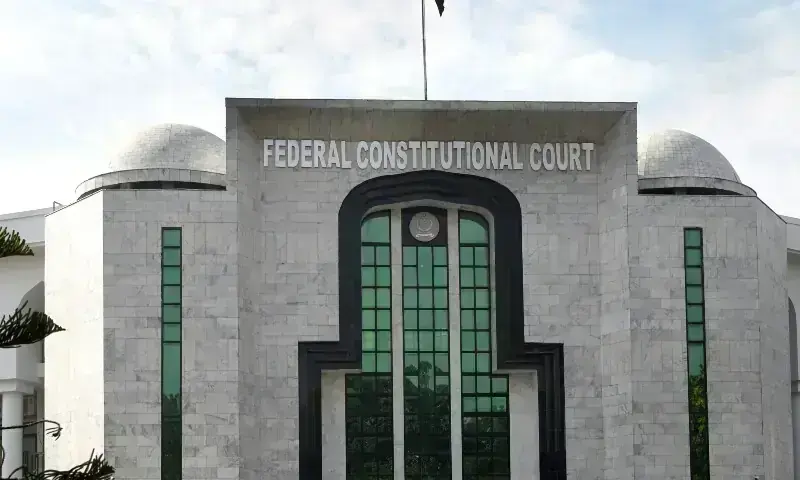
In a landmark verdict that could ripple across Pakistan's civil service, the Federal Constitutional Court (FCC) has not only struck down Balochistan's attempt to grant lifetime perks to retired chief secretaries and their widows, but it has exposed a dangerous pattern of executive overreach within the country's administrative machinery. The ruling, delivered on July 10, 2026, by a two-judge bench led by Justice Aamer Farooq, is more than a legal technicality; it is a constitutional rebuke to a provincial government that tried to rewrite the rules of entitlement without parliamentary or statutory authority. The decision sends a clear message: in Pakistan, even the most entrenched bureaucratic privileges must have a legal foundation. And for South Asia, where civil service perks often blur into patronage, the implications are far-reaching.
The constitutional firewall against bureaucratic entitlement inflation
At first glance, the dispute appears narrow: a provincial notification granting lifetime facilities to retired chief secretaries and their widows. But the FCC's ruling cuts to the heart of Pakistan's governance architecture. Justice Farooq's judgment is unequivocal: "Any action, of whatever nature, must be firmly rooted in law and must be traceable to a legal source from which it derives its authority." This principle is not just legal boilerplate, it is a constitutional firewall against the slow erosion of rule-of-law norms in a system where executive discretion has often substituted for legislative clarity.
Dawn News reported that the Balochistan government's notification, issued in 2019, was challenged before the Balochistan High Court (BHC) in 2023 by Bayazid Khan Kharooti, a citizen petitioner. The high court struck down the notification, and the FCC upheld that decision, refusing leave to appeal. The judgment dismantles the claim that such perks can be created through executive fiat. It underscores a principle long observed in Pakistan's constitutional jurisprudence: that civil service entitlements, especially those extending beyond statutory pension and gratuity, cannot be conjured from thin air. The court pointed to the Balochistan Civil Servants Act, 1974, which explicitly limits post-retirement benefits to what is "prescribed" by law. There is no prescription here, only a notification, issued by the Services and General Administration Department with the chief minister's approval, but without legal backing.
This is not an isolated case. It reflects a recurring tension in Pakistan's governance: the executive's impulse to reward its own, versus the judiciary's insistence on constitutional limits. The FCC's ruling is a rare moment of judicial pushback against what has become a culture of administrative generosity, one that risks turning civil service perks into a form of state-sponsored patronage.
Why this ruling matters beyond Balochistan's borders
Globally, the judgment is a reminder that constitutional democracies cannot function when entitlements outpace legal authorization. But in South Asia, where civil service structures are deeply embedded in post-colonial administrative traditions, the stakes are higher. In India, for instance, the Supreme Court has repeatedly struck down state attempts to grant extra pension benefits to civil servants without legislative approval. In Bangladesh, similar controversies have flared over the expansion of gratuity and pension schemes for retired officials. Pakistan's FCC has now aligned itself with this global trend: no perk without law.
The ruling also matters because it comes at a time when Pakistan's civil service is under intense scrutiny. The country faces severe fiscal constraints, with debt servicing consuming nearly half of federal revenue in recent budgets. In this context, unchecked expansion of pensionary and post-retirement benefits is not just a legal anomaly, it is a fiscal time bomb. The FCC's decision forces a reckoning: if Balochistan cannot grant lifetime perks to a retired chief secretary, what other provinces have tried, and succeeded, in doing the same? And more importantly, who is auditing these practices?
For international investors and multilateral lenders, the judgment is a signal that Pakistan's institutions are capable of enforcing fiscal discipline, even in areas traditionally shielded from scrutiny. The IMF, which has repeatedly urged Pakistan to reform its civil service pension system, may now see this ruling as a step toward broader reform. But the real test will be whether the federal government uses this precedent to audit and standardize pension rules across all provinces. Without that, the FCC's ruling risks becoming a symbolic victory with little systemic impact.
The bureaucratic privilege paradox: from colonial legacy to constitutional crisis
To understand the depth of this ruling, we must go back to the origins of Pakistan's civil service. The All-India Services Act of 1951, inherited from British India, created a cadre of elite civil servants who were guaranteed not only job security but also generous post-retirement benefits. These benefits were codified in rules framed by the Finance Department, not by individual provinces or even the federal government acting unilaterally. The FCC's judgment reaffirms this hierarchy: pension and gratuity rules are not a matter for executive whim, but for statutory law.
The Balochistan notification of 2019 attempted to bypass this structure. It was issued by the Services and General Administration Department, an entity not empowered under the Balochistan Rules of Business, 2012, to frame or extend pensionary benefits. Rule 3(4) of those rules clearly assigns such authority to the Finance Department. The FCC found that the notification was, in effect, an act of administrative overreach. Justice Farooq noted that the chief minister's approval did not cure the lack of legal competence. This is a critical point: in Pakistan, the chain of authority matters. A chief minister's signature does not grant legal power where none exists in the first place.
The judgment also raises a historical parallel. In 2016, the Supreme Court of Pakistan struck down the federal government's attempt to grant discretionary financial benefits to retired judges without parliamentary approval. That ruling, like this one, was rooted in the principle that constitutional governance requires legal authorization for state largesse. The Balochistan case is the provincial echo of that federal precedent, a reminder that the judiciary will not tolerate the circumvention of legislative authority, whether in Islamabad or Quetta.
What happened: the legal chronology of a contested perk
According to reporting by Dawn News, the controversy began with Notification No.13-25(5)/2019/SO-1(S&GAD), issued by Balochistan's Services and General Administration Department on an unspecified date in 2019. This notification purported to grant lifetime facilities, including housing, medical care, and transport, to retired chief secretaries and their widows. The notification was approved by the chief minister, but it was never tabled in the Balochistan Assembly, nor was it backed by any statutory rule or regulation.
In May 2023, the Balochistan High Court, acting on a petition filed by Bayazid Khan Kharooti, struck down the notification. The high court held that such benefits could not be granted without legal backing in the form of law, rules, or regulations. It emphasized that entitlement to perks for retired civil servants must be clearly outlined in legislation or policy, not created through executive fiat. The provincial government appealed to the FCC, arguing that the high court had erred in its interpretation of the Balochistan Rules of Business and the Civil Servants Act, 1974.
On July 10, 2026, the FCC dismissed the appeal. Justice Aamer Farooq, writing for the bench, ruled that the high court's reasoning was legally sound. He noted that the Rules of Business do not empower the provincial government to issue such directions via notification, especially when no legal source authorizes them. The court also pointed out that the Finance Department, not the Services and General Administration Department, holds exclusive authority to frame civil service rules relating to pension, leave, and pay revision. The notification, therefore, was issued without proper legal competence and was rightly struck down.
The judgment is final. There is no further appeal. The lifetime perks for retired chief secretaries in Balochistan are dead. But the legal and political questions they raised are very much alive.
Global and regional reaction: silence, support, and skepticism
At the global level, the FCC's ruling has drawn little immediate reaction. International financial institutions, including the IMF and World Bank, have long urged Pakistan to reform its civil service pension system to reduce fiscal pressure. While neither institution has issued a statement, the judgment aligns with their policy prescriptions. Analysts at the IMF's Pakistan desk have privately welcomed the ruling as a sign of judicial commitment to fiscal discipline, though they caution that the impact will depend on follow-through by the federal government.
Within South Asia, the response has been muted but telling. In India, legal experts have drawn parallels to the Supreme Court's 2019 ruling striking down the Uttar Pradesh government's attempt to grant extra pension benefits to retired teachers without legislative approval. Indian constitutional scholars see the FCC judgment as a reinforcement of the principle that post-retirement benefits must have statutory backing. In Bangladesh, where similar controversies have arisen over the expansion of gratuity schemes for civil servants, legal commentators have noted the judgment with interest, though no official reaction has been recorded.
In Pakistan itself, the reaction has been split. The Pakistan Peoples Party (PPP), which governs Sindh, has distanced itself from the Balochistan notification, emphasizing that its own pension rules are compliant with federal law. The Pakistan Tehreek-e-Insaf (PTI), in opposition, has framed the ruling as a victory for constitutional governance but has also called for a national audit of all civil service perks. Meanwhile, civil service associations have criticized the judgment, arguing that it undermines the morale of senior bureaucrats who have served with distinction. The All Pakistan Services Federation has hinted at possible protests, though no formal announcement has been made.
South Asia impact: the fiscal and institutional ripple effect
For Pakistan, the FCC's ruling is a constitutional reset, but its real impact will be felt in the provinces. Balochistan's attempt to grant lifetime perks was not an anomaly; it was a symptom of a broader trend. In Khyber Pakhtunkhwa, the provincial government has, in the past, extended housing allowances to retired officers beyond statutory limits. In Sindh, debates have flared over the expansion of medical benefits for retired civil servants. The FCC's judgment now casts a legal shadow over all such initiatives. GFN Ground Context: In 2021, the Sindh government issued a notification granting additional medical allowances to retired officers, citing "administrative necessity." That notification was quietly withdrawn after legal objections from the Sindh Finance Department. The FCC ruling gives those objections constitutional weight. For Islamabad, the challenge is clear: either bring all provincial pension rules into conformity with federal law, or risk a wave of litigation that could paralyze provincial administrations.
The fiscal implications are stark. Pakistan's civil service pension liability is estimated at over Rs 1.2 trillion annually, nearly 3% of GDP. Unchecked expansion of post-retirement benefits could push this figure higher, straining an already fragile fiscal position. The FCC's ruling is a reminder that the solution is not to invent new perks, but to reform the pension system itself. Options include raising the retirement age, indexing pensions to inflation within sustainable limits, or introducing contributory pension schemes. But these reforms require political courage, and a legislature willing to act.
For South Asia, the judgment is a cautionary tale. In India, Bangladesh, and Sri Lanka, civil service pensions are a perennial source of fiscal strain. In India, the Seventh Pay Commission's recommendations led to a 23% increase in pension liabilities in 2016. In Bangladesh, the government has struggled to cap pension growth despite repeated attempts. Pakistan's FCC has now set a precedent: no perk without law. The question for Islamabad is whether it will use this ruling to launch a regional standard for fiscal discipline, or whether it will allow the provinces to continue their quiet expansion of bureaucratic privilege.
What happens next: the road to reform or the slide into precedent erosion
Analysts expect three possible trajectories in the coming months. The most likely outcome is that the federal government will use the FCC ruling as a catalyst to audit and standardize civil service pension rules across all provinces. The Ministry of Finance has already signaled its intention to review the Balochistan case and assess whether similar notifications exist elsewhere. A federal task force could be formed to draft a uniform pension policy, applicable to all civil servants, whether in Islamabad, Quetta, Peshawar, or Karachi. Such a policy would need to be tabled in parliament and passed as law, a process that could take up to two years, given Pakistan's legislative gridlock.
A second scenario is that the provinces will resist. Civil service associations may lobby provincial assemblies to pass laws retroactively validating the perks that were struck down. This would trigger a constitutional crisis, pitting provincial legislatures against the judiciary. The Supreme Court of Pakistan would likely be called upon to resolve the conflict, setting up a showdown between judicial review and legislative supremacy. Such a confrontation could erode public trust in both institutions.
A third possibility is inertia. The federal government could ignore the FCC ruling, allowing the provinces to continue their practices under the radar. This would be the most dangerous outcome. It would normalize executive overreach, undermine fiscal discipline, and send a signal to international lenders that Pakistan's institutions are not yet capable of self-reform. The IMF's next review, due in late 2026, may include a specific benchmark on civil service pension reform. Failure to act could delay disbursements and trigger a balance-of-payments crisis.
The real question for Islamabad is whether the FCC's ruling will be the beginning of a systemic cleanup, or just another legal footnote in a history of unchecked administrative privilege. For South Asian readers, the stakes are clear: in an era of scarce resources, unchecked bureaucratic entitlement is not just unfair to taxpayers, it is a threat to macroeconomic stability.
Related Coverage
Global Economy Analysis → — In-depth analysis, background context, and continuous updates on this developing story.
Key Takeaways
- The FCC ruling is a constitutional firewall against executive overreach. It reaffirms that civil service perks cannot be created by notification alone, they require legislative or statutory backing. This principle applies not just in Balochistan, but across Pakistan's provinces.
- Fiscal discipline is now the unspoken subtext of the judgment. With Pakistan's debt-to-GDP ratio exceeding 70%, unchecked expansion of pension liabilities risks triggering a fiscal crisis. The ruling forces a reckoning: either reform the pension system, or watch it consume an ever-larger share of public revenue.
- The judgment sets a regional precedent, and a regional challenge. South Asian governments grappling with civil service pension liabilities will watch closely. If Pakistan succeeds in reforming its system, others may follow. If it fails, the cycle of unchecked privilege will continue.