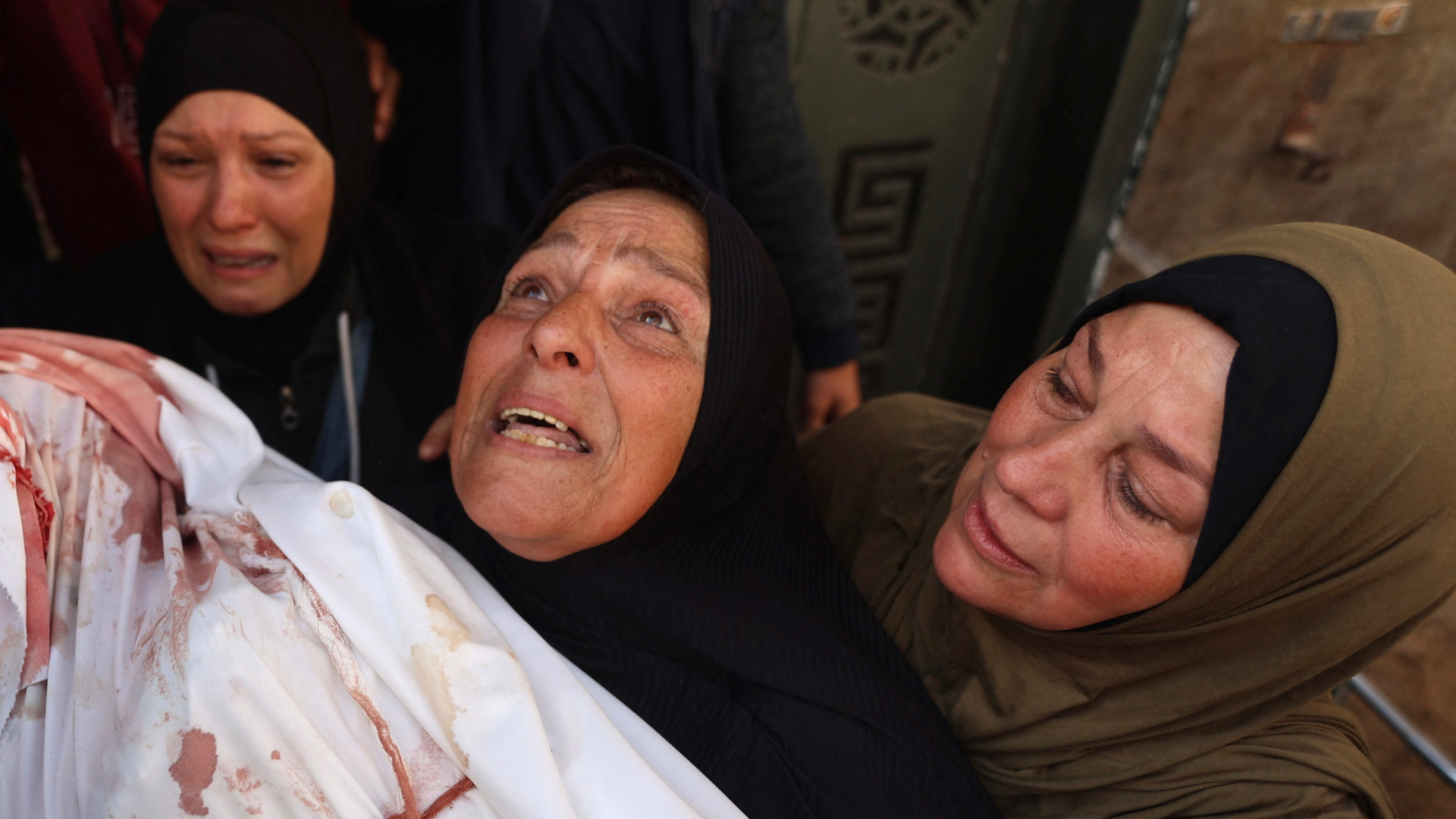
Gaza is not just divided, it is being carved into a permanent humanitarian wasteland. Two million Palestinians now live under Hamas's fractured authority in less than half the territory, their lives suspended in a limbo of rubble and ration cards. The October 2025 ceasefire, sold as a pathway to peace, has instead become a blueprint for perpetual blockade. And the man tasked with selling this vision to the world, UN envoy Nickolay Mladenov, just told the Security Council what everyone already fears: if this status quo hardens, Gaza will not recover. It will calcify.
Why This Matters
The stakes are not just humanitarian, they are geopolitical in the most dangerous sense. A Gaza frozen in division is a Gaza that becomes a permanent incubator for radicalization, a launchpad for militancy that spills across borders into Egypt, Jordan, and beyond. It is also a Gaza where Israel's long-term security narrative, "security through separation", collapses into a self-fulfilling prophecy of perpetual siege. Economically, the cost of inaction is staggering: reconstruction funds won't flow while weapons remain in play, and the longer Gaza stays a ward of international aid, the more the world's attention, and resources, will drift toward other crises. For the United States, the Board of Peace initiative was meant to stabilize a volatile region. Instead, it risks becoming a cautionary tale of how ceasefires without enforcement become the seeds of the next war.
Background & Context
The current crisis did not emerge from a vacuum. It is the latest chapter in a decades-long cycle of violence that began long before October 7, 2023. That date, however, marks a rupture. The Hamas-led attack on southern Israel killed 1,200 people and took over 200 hostages, triggering Israel's most devastating military campaign in Gaza since 2014. The death toll, over 72,775 Palestinians as of Mladenov's briefing, has surpassed even the grim statistics of the 2014 war, when 2,200 Palestinians and 73 Israelis died.
The October 2025 ceasefire was brokered under US auspices, but it was not the first attempt at halting the bloodshed. The 2014 ceasefire, negotiated by then-Secretary of State John Kerry, collapsed within weeks as Hamas and Israel accused each other of violations. The 2021 ceasefire, which ended an 11-day war, lasted only three months before tensions reignited. This time, the US framed the deal as a two-phase process: Phase One focused on halting hostilities and restoring basic services, while Phase Two, now stalled, was supposed to address Hamas's disarmament, governance, and the phased withdrawal of Israeli forces. But the October 2023 war was not just another round of fighting. It was a regional escalation, drawing in Iran-backed militias in Lebanon, Syria, and Yemen, and prompting direct Israeli strikes on Iranian soil. The global energy crisis, triggered by Russia's invasion of Ukraine and exacerbated by Houthi attacks in the Red Sea, has further distracted world powers from Gaza's plight.
What Happened
On Thursday, Nickolay Mladenov stood before the UN Security Council and delivered a blunt warning: "The risk is that the deteriorating status quo becomes permanent." His words were not hypothetical. They were a diagnosis of a system already in collapse. The ceasefire, announced in October 2025, was supposed to bring relief. Instead, it has brought more violence. Since the truce was declared, Israeli drone strikes have killed at least 26-year-old civilians in al-Mahatta, east of Deir el-Balah. Settler raids and military operations in the West Bank have surged, with monitors reporting a 40% increase in violent incidents since the ceasefire took hold. The Israeli military still controls over 50% of Gaza's territory, a fact that undermines any claim of Palestinian sovereignty or reconstruction.
The US, which brokered the deal, has moved the process into "Phase Two," but the transition has stalled for weeks. The roadmap calls for Hamas's disarmament, the establishment of a panel of Palestinian technocrats to govern Gaza, and the gradual withdrawal of Israeli forces. Yet none of this has materialized. The international stabilisation force, envisioned as a buffer between Hamas and Israel, remains a proposal on paper. Meanwhile, the humanitarian crisis deepens. Over 85% of Gaza's population is displaced, living in tents or overcrowded shelters. Food insecurity is at famine levels in the north, and diseases like cholera are spreading due to collapsed sanitation systems. Mladenov's warning, that reconstruction financing will not follow where weapons have not been laid down, is not just a prediction. It is a description of the current reality.
Global & Regional Reaction
The international response to Mladenov's warning has been fragmented, reflecting the broader paralysis in global governance. The United States, which has been the primary backer of the Board of Peace initiative, has yet to publicly pressure Israel to accelerate Phase Two. Secretary of State Antony Blinken, speaking in Davos last month, acknowledged the "urgent need" for progress but offered no concrete steps to break the deadlock. The European Union, meanwhile, has called for an immediate lifting of Israeli restrictions on humanitarian aid, but its leverage is limited by divisions among member states. France and Germany have taken a harder line against settlement expansion, while Hungary and Austria have resisted stronger measures, citing concerns over migration and energy security.
In the Middle East, reactions have been equally mixed. Egypt, which has mediated past ceasefires, has warned of a "catastrophic" collapse if the status quo persists but has ruled out reopening the Rafah crossing without guarantees of Israeli restraint. Jordan's King Abdullah II, in a rare public address, described Gaza as a "ticking time bomb" that threatens regional stability. Saudi Arabia, which has been quietly engaging with Hamas through backchannel talks, has warned that the continued blockade risks pushing Palestinians toward extremist groups. Iran, meanwhile, has accused Israel of using the ceasefire as cover to consolidate its occupation, while its proxies in Lebanon and Yemen have escalated attacks on Israeli targets, raising fears of a wider conflagration.
The most striking silence has come from the Arab League. After decades of championing the Palestinian cause, the League's recent summit in Cairo produced only a tepid statement calling for "restraint." The absence of a unified Arab position reflects a broader exhaustion with the Palestinian issue, as regional powers pivot toward economic integration and security partnerships with Israel. But Gaza's crisis is not a regional problem that can be ignored. It is a wound that festers, and wounds, left untreated, always spread.
South Asia Impact
While Gaza burns, South Asia watches, and worries. The region's fraught history with militancy, its dependence on Middle Eastern energy, and its strategic location between the Indian Ocean and Central Asia make it acutely sensitive to any escalation in the Levant. Pakistan, which has long positioned itself as a defender of the Palestinian cause, has condemned Israel's actions in Gaza but has also faced criticism for its own crackdowns on domestic protests. The government of Prime Minister Shehbaz Sharif has called for an immediate ceasefire and the lifting of the blockade, but its ability to influence events is limited by its economic crisis and political instability. Still, Islamabad's rhetoric matters. The country's powerful military and intelligence establishment maintains ties with Hamas and other militant groups, and any perception that Pakistan is failing to act could embolden hardline factions within its borders.
India, meanwhile, has taken a more cautious approach. New Delhi has condemned the October 7 attacks and expressed support for Israel's right to self-defense, but it has also called for a "just and lasting solution" to the Palestinian issue. India's growing strategic partnership with Israel, particularly in defense and technology, has complicated its stance, but its energy imports from the Middle East and its large Muslim minority population make it wary of appearing too aligned with Tel Aviv. The government of Narendra Modi has avoided strong criticism of Israel's military campaign, but its silence is not indifference. India has quietly pushed for a political solution, fearing that a prolonged crisis in Gaza could destabilize the broader region and threaten its energy supplies from the Gulf.
The humanitarian fallout is already visible. South Asian diaspora communities, particularly in the Gulf states, have organized protests and fundraisers for Gaza, but the crisis has also fueled tensions at home. In India, protests in Kashmir and Uttar Pradesh have drawn parallels between Gaza and the disputed territory, with some groups accusing the government of double standards. In Pakistan, social media campaigns have gone viral, with users sharing graphic images of Palestinian casualties alongside calls for jihad. The risk is not just rhetorical. A prolonged crisis in Gaza could radicalize a new generation of South Asian Muslims, providing recruitment fodder for groups like Lashkar-e-Taiba or Jaish-e-Mohammed, which have historically targeted India and Afghanistan. The region's intelligence agencies are already on high alert, but the longer Gaza remains a festering wound, the harder it will be to contain the spillover.
What Happens Next
The most likely outcome, analysts say, is a prolonged stalemate. The US, distracted by its own domestic crises and the war in Ukraine, has little appetite for a fresh diplomatic push. Israel, meanwhile, has no incentive to withdraw from Gaza while Hamas retains any military capacity. And Hamas, despite its weakened state, has shown no willingness to disarm without guarantees of Palestinian statehood, a demand Israel has repeatedly rejected. The result is a deadlock that benefits no one but the spoilers: extremist groups that thrive in chaos, and hardline factions in both Israel and Palestine that see peace as a threat to their power.
A key question is whether the international community will finally impose consequences for violations of the ceasefire. The UN Security Council has the tools, sanctions, arms embargoes, or even referrals to the International Criminal Court, but it lacks the unity to use them. China and Russia, both permanent members, have blocked past resolutions critical of Israel, while the US has shielded Israel from accountability in the past. The only glimmer of hope lies in the stalled second phase of the US roadmap. If the panel of Palestinian technocrats can be assembled and given real authority, it could provide a pathway out of the current impasse. But for that to happen, Israel must agree to meaningful concessions, something it has shown little inclination to do.
Another scenario is a regional escalation. The longer Gaza remains a powder keg, the greater the risk that Iran or its proxies will exploit the crisis to open new fronts. Israel's recent strikes on Iranian nuclear sites and Hezbollah positions in Lebanon suggest that it is preparing for a broader conflict. If that happens, South Asia will feel the tremors. Energy prices will spike, diaspora communities will become more inflamed, and governments will face mounting pressure to take sides. The last time the Middle East spiraled into a regional war, in 1973, during the Yom Kippur War, South Asia's oil-dependent economies suffered severe shortages and inflation. Today, with the global energy system already strained, the impact could be even more severe.
The most dangerous outcome, however, is not another war. It is the slow, creeping normalization of Gaza's suffering. A generation of Palestinians growing up in tents, dependent on aid, with no hope of reconstruction or statehood. A generation of Israelis who see separation as the only path to security, even if it means perpetual occupation. And a world that has moved on, content to let the crisis fester as long as it doesn't spill over into their own backyards. That, Mladenov warned, is the scenario that "Israelis, Palestinians, and the region should all fear." The question is whether anyone will listen before it's too late.
Related Coverage
Middle East Conflict Analysis → — In-depth analysis, background context, and continuous updates on this developing story.
Key Takeaways
- Gaza's ceasefire has calcified into a permanent humanitarian crisis. The October 2025 truce, meant to end hostilities, has instead entrenched a divided enclave where two million Palestinians live under Hamas's fractured rule and Israeli military control, with no path to reconstruction or statehood.
- The stalled second phase of the US roadmap risks turning Gaza into a permanent war economy. Without Hamas's disarmament and the deployment of an international stabilisation force, the enclave will remain a lawless zone where militancy thrives and reconstruction funds never arrive.
- South Asia's stability is tethered to Gaza's fate. A prolonged crisis risks radicalizing diaspora communities, fueling militancy in Pakistan and Kashmir, and destabilizing energy supplies from the Gulf, all while governments in Islamabad and New Delhi struggle to balance strategic interests with domestic pressure.