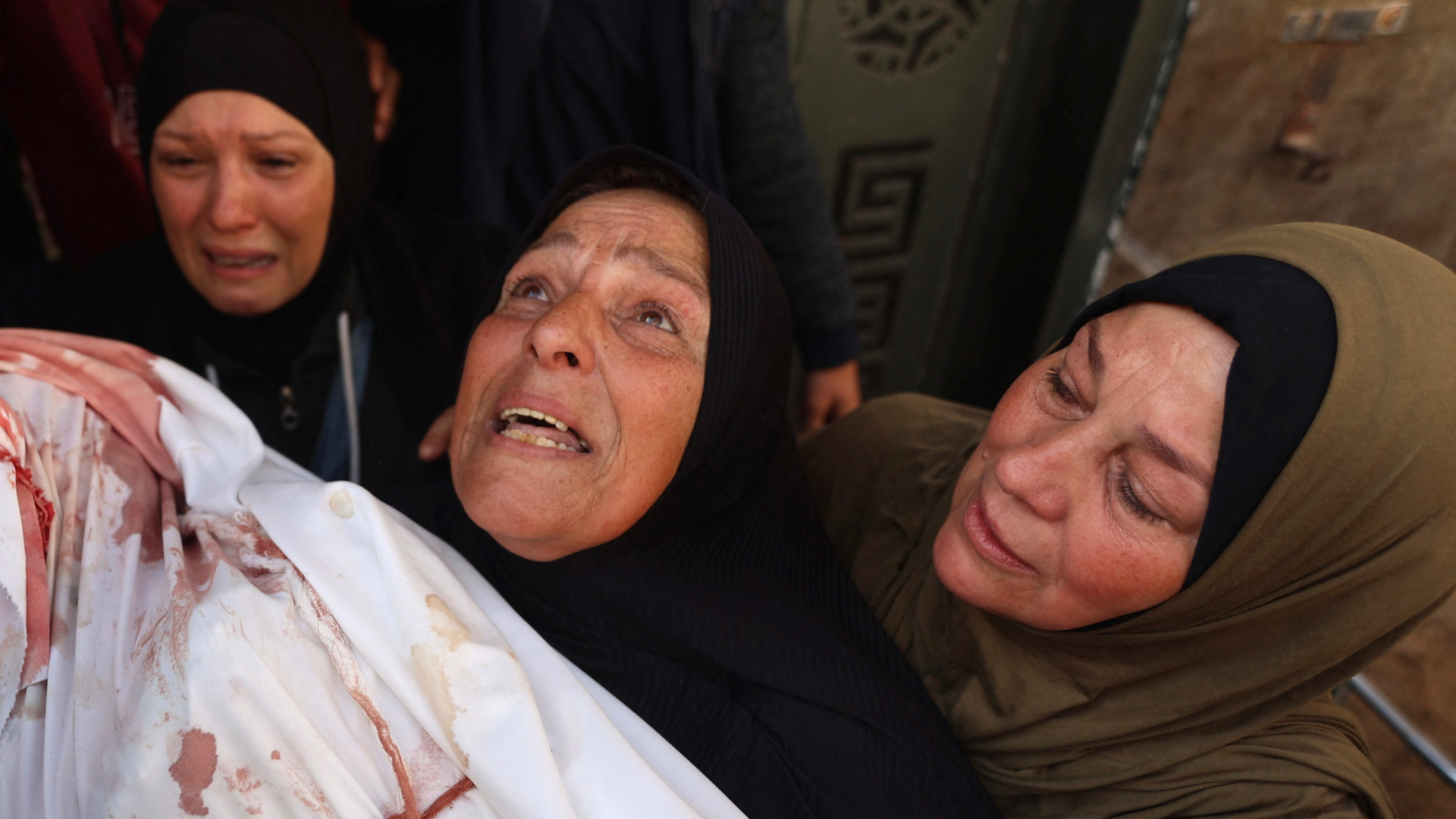
Three-year-old Yahya al-Malahi never made it to the wedding. Dressed in new clothes, his small hand clutching his father's sleeve, he stepped onto al-Nafaq Street in Gaza City on 25 April 2026, just as an Israeli missile struck a nearby police vehicle. The blast tore through the market, killing Yahya instantly and scattering vendors into the smoke. His father, kneeling in the dust, cradled the lifeless body, whispering, "May God compensate us with something good," over and over, as if repetition could stitch the world back together.
This was not an aberration. It was the rule. Months after the US-brokered "ceasefire" between Israel and Hamas took effect in October 2025, Gaza remains a killing field. Hospitals collapse under the weight of the wounded. Crossings stay shut. Children die on their way to celebrations. And the United States, once hailed as a force for justice, now stands accused by survivors of enabling what the UN High Commissioner for Human Rights calls "continuing disregard for Palestinian lives, enabled by sweeping impunity."
But why does this matter beyond the Strip? For South Asia, the story is not just about Gaza, it's about what happens when Washington arms Israel to the teeth while calling it "peace." It's about the message sent to every Muslim-majority nation watching: that American support for Israel is not conditional on human life. And it's about the dangerous precedent this sets for how Washington treats allies, and adversaries, across the Global South.
The Ceasefire That Was Never Meant to Stop the Bombs
The October 2025 US-Israel ceasefire was never a true truce. It was a tactical pause, a moment for Israel to regroup, rearm, and redefine the rules of engagement. According to reporting by Middle East Eye, the agreement included no enforcement mechanism, no international monitoring, and no commitment to lift the blockade on Gaza. Instead, it allowed Israel to claim legitimacy while continuing to target what it labeled "militants", a category that, in Gaza, includes anyone walking near a police vehicle, a market, or a hospital.
This is not the first time a ceasefire in Gaza has been a facade. In 2014, after 50 days of bombardment during Operation Protective Edge, a fragile truce was brokered, only for Israel to resume strikes within months, citing "militant activity." In 2021, another ceasefire collapsed within weeks as Israeli forces raided Al-Aqsa Mosque during Ramadan, triggering an 11-day war. The pattern is clear: ceasefires in Gaza are not peace agreements. They are breathing spells for war.
But the 2025 version is different. This time, the United States did not just broker the deal, it actively enabled it. American weapons, intelligence, and diplomatic cover allowed Israel to maintain the siege while claiming compliance with international law. When the UN condemned the strikes, the US vetoed resolutions. When human rights groups documented war crimes, Washington dismissed them as "biased." The message was unmistakable: Palestinian lives are negotiable.
Why This Ceasefire Is a Warning for South Asia
The real question for Islamabad, and for every Muslim-majority capital from Ankara to Jakarta, is this: if the United States can greenlight the mass killing of Palestinian children with impunity, what's stopping it from doing the same elsewhere when its interests are at stake?
Consider the implications for South Asia. Pakistan, already grappling with a fragile economy and a fragile democracy, watches as Washington arms Israel while calling it "self-defense." Islamabad has long relied on American assurances in its own conflicts with India, assurances that now ring hollow. If the US can ignore Palestinian casualties, can it ignore Kashmiri ones? If it can dismiss UN condemnations for Gaza, can it dismiss them for Srinagar?
There's a historical parallel here. In 1971, the US under Nixon backed Pakistan's military junta despite its atrocities in East Pakistan (now Bangladesh), fearing India's tilt toward the Soviet Union. The result? A genocide that killed three million, a war that redrew the map of South Asia, and a US that abandoned its moral authority. Today, Washington is repeating the same calculus, arming an ally (Israel) while ignoring its crimes, all in the name of strategic alignment. The lesson for South Asia is chilling: when the US needs a partner, human rights are the first casualty.
This is not just a Middle Eastern crisis. It's a South Asian one. The same logic that allows Israel to bomb Gaza with American weapons is the logic that could one day justify Washington looking the other way as New Delhi acts in Kashmir, or as Islamabad acts in Balochistan. The ceasefire in Gaza is not a peace deal. It's a permission slip.
What Happened in Gaza After the Ceasefire
On 14 April 2026, an Israeli airstrike hit a café in the al-Shati (Beach) Camp in western Gaza City, killing at least five people and critically injuring others. The strike also destroyed a power generator supplying electricity to most of western Gaza, plunging neighborhoods into darkness. According to Middle East Eye, the attack occurred in broad daylight, with no immediate claim of responsibility from Hamas or other armed groups. The Israeli military later stated it had targeted a "militant compound," but provided no evidence to support the claim.
Days earlier, on 25 April, an Israeli artillery strike on al-Nafaq Street in Gaza City killed four people, including three-year-old Yahya al-Malahi, and injured nine. The strike occurred near Kamal Adwan Hospital in Beit Lahia, where mourners wept beside the bodies of the dead. Footage showed Yahya's father cradling his son's lifeless body, blood soaking the child's new clothes, as he repeated, "May God compensate us with something good."
The pattern is consistent: strikes on civilian infrastructure, no accountability, and a media narrative that frames Palestinian deaths as collateral damage rather than war crimes. The ceasefire, far from ending the violence, has merely given Israel the cover to escalate its campaign with fewer international objections. The US, meanwhile, has continued to supply weapons, block UN resolutions, and dismiss reports of civilian casualties as "unverified."
In Jabalia, a densely populated refugee camp turned displacement site, 14-year-old Ahmed Halawa was shot by Israeli occupation forces. His body was rushed to Al-Shifa Hospital, where he was declared dead. His family gathered in grief, their faces etched with the same exhaustion that has defined Gaza for generations. These are not isolated incidents. They are the daily reality of a population trapped in an open-air prison, where the only thing more dangerous than the bombs is the silence of the world.
Global and Regional Reaction: A World That Looks Away
International condemnation has been swift but toothless. The United Nations High Commissioner for Human Rights described the strikes as evidence of "continuing disregard for Palestinian lives, enabled by sweeping impunity." The European Union called for "restraint" but stopped short of sanctions. Arab states, including Egypt and Jordan, summoned Israeli ambassadors to protest, but did not threaten to downgrade relations. Turkey and Iran, meanwhile, have been more vocal, with Turkish President Recep Tayyip Erdoğan accusing Israel of "state terrorism" and Iran's Supreme Leader Ayatollah Ali Khamenei calling for "resistance" against "American-backed aggression."
But the most consequential silence has come from Washington. The US has not only continued to supply Israel with weapons, it has blocked multiple UN Security Council resolutions condemning the strikes. When asked about civilian casualties, a US State Department spokesperson stated, "Israel has the right to defend itself," a refrain that has become the diplomatic equivalent of a blank check. Even as images of Yahya al-Malahi's body circulated on social media, the White House issued no condemnation, no call for restraint, no acknowledgment of the child's death. The message was clear: Palestinian lives do not matter in the calculus of American power.
In South Asia, the reaction has been muted but telling. Pakistan's Foreign Office issued a statement calling the strikes "a flagrant violation of international law" but stopped short of recalling its ambassador or imposing sanctions. India, meanwhile, has maintained its long-standing position of supporting Israel's "right to self-defense," a stance that has drawn criticism from Muslim-majority nations but little pushback from Washington. The message to Islamabad is unmistakable: if you want American support, you must accept the cost of Palestinian suffering as collateral damage.
GFN Editorial: The Gaza ceasefire is not a peace deal, it's a permission slip for impunity. For South Asian readers, the lesson is stark: when Washington arms Israel without conditions, it signals that human rights are negotiable. This sets a dangerous precedent for how the US may treat allies in the region when their own conflicts, whether in Kashmir or Balochistan, come under scrutiny. The real question for Islamabad is whether it will continue to trust a superpower that treats Palestinian lives as expendable.
South Asia Impact: When Washington Arms Impunity, Who Pays the Price?
For Pakistan, the Gaza ceasefire is more than a humanitarian crisis, it's a geopolitical earthquake. Islamabad has long relied on American assurances in its standoffs with India, from the 1965 war to the 2019 Balakot crisis. But when Washington can ignore the mass killing of children in Gaza while continuing to arm the perpetrators, what does that say about its commitment to human rights in South Asia?
GFN Ground Context: Pakistan has faced this dilemma before. In 2019, after India's airstrikes on Balakot, Islamabad turned to Washington for support, only to find that the US was more interested in maintaining its strategic partnership with New Delhi than in condemning aggression. The lesson was clear: in Washington's calculus, Pakistan's security is negotiable. Today, as Gaza burns, the same calculus is on display. The US is not just arming Israel, it's normalizing the idea that some lives are worth less than others. For Pakistan, this is a warning: when the next crisis erupts in Kashmir or along the Line of Control, Washington may again prioritize its alliances over justice.
The economic fallout is already visible. Pakistan's trade corridors, already strained by inflation and debt, could face further disruptions if the US pressures Islamabad to align with its policies in the Middle East. The China-Pakistan Economic Corridor (CPEC), a lifeline for Pakistan's economy, could become a bargaining chip in Washington's broader strategy to isolate Beijing. If the US can ignore Palestinian suffering, it can ignore Pakistani sovereignty, and that's a risk no government in Islamabad can afford to take.
But the most dangerous implication is psychological. For decades, Pakistan has positioned itself as the defender of Muslim rights, from Palestine to Kashmir. But when Washington can bomb Gaza with impunity, what does that say about the limits of Muslim solidarity? The ceasefire in Gaza is not just a Middle Eastern issue, it's a South Asian one. It's about whether Islamabad can still claim moral authority when the world's most powerful nation treats Muslim lives as expendable.
What Happens Next: The Ceasefire That Never Was
Analysts expect the violence in Gaza to escalate in the coming months. The ceasefire, far from ending the conflict, has given Israel the breathing room to rearm and redefine its targets. According to Middle East Eye, Israeli military officials have already indicated that they will not tolerate any "militant activity" near the border, code for any Palestinian presence in areas Israel deems its own. This could mean more strikes on markets, hospitals, and refugee camps, all under the guise of "self-defense."
A key question is whether the US will continue to provide unconditional support. The Biden administration has already faced criticism from progressive Democrats and Muslim-American voters over its stance on Gaza. If the violence escalates further, Washington may face pressure to rethink its approach, but analysts doubt it will go beyond symbolic gestures. The US has invested too much in Israel's military dominance to walk away now.
In South Asia, the implications are equally dire. If the US can ignore Palestinian suffering, it can ignore Kashmiri suffering. If it can dismiss UN condemnations for Gaza, it can dismiss them for Srinagar. The real risk is not just more bombs in Gaza, but a normalization of impunity that spreads across the Muslim world. For Pakistan, the challenge will be to balance its strategic relationship with Washington while maintaining its moral stance on Palestine. But the Gaza ceasefire has made that balance nearly impossible. The message from Washington is clear: human rights are negotiable. The question for Islamabad is whether it will accept that.
Related Coverage
Global Economy Analysis → — In-depth analysis, background context, and continuous updates on this developing story.
Key Takeaways
- Washington's unconditional support for Israel has turned the Gaza ceasefire into a license for continued violence. The US is not just brokering peace, it's enabling war crimes by providing weapons, intelligence, and diplomatic cover.
- For South Asia, the lesson is that American assurances are conditional on strategic alignment, not human rights. The Gaza ceasefire sets a dangerous precedent for how Washington may treat allies in the region when their own conflicts come under scrutiny.
- The real risk is not just more bombs in Gaza, but the normalization of impunity across the Muslim world. If the US can ignore Palestinian suffering, it can ignore Kashmiri suffering, and that's a message no South Asian capital can afford to ignore.


