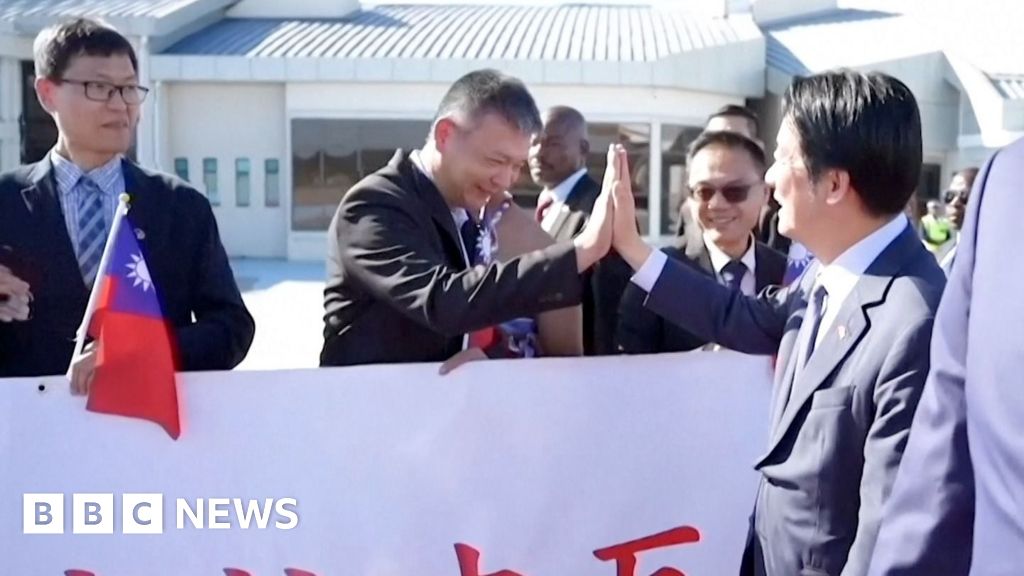
Taiwan's President Lai Ching-te arrived in Eswatini on July 8, 2026, not by scheduled diplomatic jet, but by a route so carefully concealed that even the host government kept the visit secret until the last moment. The journey followed a humiliating cancellation of Lai's original April trip when Seychelles, Mauritius, and Madagascar abruptly revoked airspace rights under what Taiwan called "Chinese pressure." Beijing's response was swift: it branded the visit a "stowaway-style escape farce," accusing Taipei of "colluding with external forces" to cling to dwindling allies. Yet the real story is not the theatrics in Mbabane, but the unraveling of China's decade-long campaign to isolate Taiwan diplomatically in Africa, and the ripple effects that now stretch from the Indian Ocean to the Himalayas.
The Global Domino Effect of Airspace Diplomacy
This is the first time a Taiwanese president has been forced to reroute an international trip via clandestine air corridors, but it won't be the last. The episode exposes a critical vulnerability in China's strategy: its ability to weaponize airspace access is now so pervasive that even neutral island states in the Indian Ocean cannot resist Beijing's demands without risking economic retaliation. According to reporting by BBC News, the three African island nations reversed their flight permissions within 48 hours of what Taiwan described as "diplomatic pressure," a phrase that understates the coercive nature of the episode. The message to Taipei is clear: China can strangle Taiwan's global mobility without firing a shot. But the message to the rest of the world, especially to South Asian capitals, is more ominous. If airspace sovereignty can be traded like currency in the Indian Ocean, what happens when the same tactic is applied to the Bay of Bengal or the Arabian Sea? The stakes are not just diplomatic. They are about the future of global trade routes, military transit rights, and the very architecture of sovereignty in the 21st century.
The incident also marks a turning point in Taiwan's foreign policy. For years, Taipei has relied on symbolic solidarity from small states like Eswatini, Guatemala, and Paraguay to maintain the fiction of statehood. But when even a ceremonial overflight becomes a bargaining chip, the fragility of that strategy is laid bare. Lai's arrival in Eswatini, unannounced, unpublicized, and unprotected by international law, is less a victory for Taiwanese diplomacy than a testament to its desperation. Eswatini remains Taiwan's only ally in Africa, a distinction it holds through a mix of ideological alignment and economic aid. But the cost of that loyalty is rising. The customs agreement signed during the visit, while modest, underscores the narrowing options for Taipei: either accept deeper dependence on a shrinking network of patrons or risk becoming a diplomatic ghost state.
The China-Taiwan Proxy War Moves South: Eswatini as a Test Case for the Indo-Pacific
Eswatini is not an isolated case. It is a pressure point. For Beijing, every Taiwanese ally is a wound that must be cauterized. For Taipei, every ally is a lifeline that must be defended. But the geography of this contest is shifting. Eswatini sits at the edge of the Indian Ocean, a region where China's maritime ambitions are colliding with India's strategic imperatives. The same airspace that once seemed like a neutral corridor is now a contested zone. In 2023, Mauritius and Seychelles both signed deep-sector economic deals with China, deals that included infrastructure loans and port access. By 2025, both had joined the chorus of nations revoking flight permissions for Taiwanese officials. The pattern is unmistakable: Beijing is leveraging economic dependency to enforce political obedience, and the air above the Indian Ocean is the first battleground.
This is not the first time China has used airspace as a tool of coercion. In 2020, Lithuania found itself at the center of a similar storm when Beijing blocked its aircraft from flying over Chinese airspace after Vilnius allowed Taiwan to open a representative office under the name "Taiwan." The episode lasted months and cost Lithuania millions in rerouted flights. But the stakes in the Indian Ocean are higher. The region is a chokepoint for global shipping, a corridor for energy supplies from the Gulf to East Asia, and a potential flashpoint in any future conflict over Taiwan. If China can control the skies over Mauritius, it can control the flow of goods and information. If it can dictate who flies where, it can dictate who survives in the diplomatic arena. The Eswatini incident is a warning: the airspace weapon is spreading, and South Asia is next on the list.
For India, the implications are immediate. New Delhi has long watched China's infrastructure investments in Sri Lanka, the Maldives, and Pakistan with unease. But the weaponization of airspace adds a new dimension. India's own air corridors are already congested, and its military relies on overflight rights for rapid deployment. If China can pressure small island states to deny transit to Taiwanese officials, could it also pressure them to deny transit to Indian military aircraft? The question is not academic. In 2021, during the Ladakh standoff, India rerouted fighter jets to avoid Pakistani airspace. A similar reroute through the Indian Ocean would be far costlier. The Eswatini episode forces a reckoning: the era of unchallenged airspace sovereignty is over, and South Asia is caught in the middle.
What Happened: The Secret Flight, the Revoked Permits, and the Diplomatic Standoff
According to reporting by BBC News, Taiwan President Lai Ching-te's original itinerary for April 22-26, 2026, was to attend the 40th anniversary of Eswatini's King Mswati III's accession. The trip was part of Taipei's efforts to reinforce ties with its last African ally amid intensifying Chinese pressure. But days before departure, three Indian Ocean island nations, Seychelles, Mauritius, and Madagascar, suddenly withdrew flight permits for Lai's aircraft. Taiwan's government alleged the revocations were the result of "Chinese pressure," though neither Beijing nor the island states provided public confirmation. The sudden reversal left Taipei with two options: cancel the trip or find an alternative route. It chose the latter.
How Lai reached Eswatini remains unclear. His office stated that "days of careful arrangements by the diplomatic and national security teams" secured his passage, but offered no details on the flight path, refueling stops, or the identities of the countries that granted clearance. What is known is that the visit was kept secret until the last moment. Images released by Taiwan's presidential office showed Lai being greeted at Matsapha International Airport by Eswatini's Prime Minister Russell Dlamini, flanked by a guard of honor. The delegation included Foreign Minister Lin Chia-lung and National Security Council Adviser Alex Huang, signaling the trip's high stakes.
During the visit, Lai and King Mswati III signed a customs cooperation agreement, a move Taipei framed as strengthening economic ties. Lai also took to social media to praise Eswatini for "standing firm against various diplomatic and economic pressure," framing the visit as a defiant act of solidarity. But the triumphant rhetoric masked a deeper reality: Taiwan's ability to project power, even symbolically, is shrinking. Eswatini is one of just 12 states that still recognize Taipei, and its willingness to host Lai under such circumstances is less a show of strength than a sign of isolation. Beijing, for its part, dismissed the visit as a "farce," arguing that no amount of theatrics could change the "fact" that Taiwan is part of China. The ministry's statement was a reminder: in Beijing's view, the diplomatic game is already over. The only question is how long Taipei will keep playing.
Global and Regional Reaction: From Beijing's Mockery to Washington's Silence
The international response to Lai's Eswatini trip has been a study in contrasts. Beijing's reaction was swift and scathing. The foreign ministry issued a statement calling the visit a "stowaway-style escape farce," a phrase that blends ridicule with menace. The ministry also reiterated China's longstanding position: "Taiwan is part of China," and no amount of diplomatic maneuvering can alter that reality. The language was vintage Beijing, uncompromising, ideological, and designed to isolate Taipei further. The statement did not acknowledge the airspace revocations or the pressure on island nations, but the implication was clear: China's reach extends beyond its borders, and those who defy it will pay the price.
Taipei's allies, meanwhile, offered cautious support. The United States, Taiwan's most vocal backer, did not issue a formal statement on the Eswatini trip, though State Department officials reiterated their commitment to "Taiwan's ability to engage with the world." The lack of a stronger response reflects Washington's growing caution in the Indo-Pacific, where it is balancing support for Taipei with the need to avoid direct confrontation with Beijing. Japan, another key ally, also stayed silent, though Japanese media highlighted the incident as evidence of China's expanding coercive toolkit.
In Africa, reactions were mixed. Eswatini's government framed the visit as a reaffirmation of its sovereignty and a rejection of "external interference." King Mswati III, in a rare public statement, praised the visit as a "symbol of resilience." But other African nations remained conspicuously quiet. Mauritius and Seychelles, both of which revoked flight permits, did not comment publicly, though their actions spoke volumes. The African Union, which officially recognizes China's "One China" policy, also stayed silent, a reflection of the continent's growing economic dependence on Beijing. The episode underscored a harsh truth: in the battle for diplomatic recognition, Africa is no longer a battleground, it is a prize Beijing has already claimed.
The absence of a robust global response is telling. The international community has grown accustomed to China's coercive diplomacy, whether in the South China Sea, the Himalayas, or the Taiwan Strait. But the Eswatini incident is different. It is not about territory or resources. It is about the very idea of sovereignty, the right of a state to control its own airspace and to choose its own friends. If that right can be traded away, the implications for the global order are profound. The silence from Washington and other capitals suggests that the world is still grappling with how to respond to this new form of pressure. The question is whether they will wake up in time.
GFN Editorial: For South Asian readers, the Eswatini episode is a cautionary tale about the weaponization of airspace and the erosion of diplomatic autonomy. The incident shows how China's economic leverage is being converted into geopolitical control, not just in its immediate periphery but across entire oceanic corridors. For Islamabad, the lesson is clear: if Mauritius and Seychelles can be pressured to deny airspace to a Taiwanese president, could Karachi or Gwadar face similar demands in a future crisis? The risk is not hypothetical. In 2019, during the Pulwama crisis, India rerouted military flights to avoid Pakistani airspace, a move that exposed the vulnerability of even major powers to airspace coercion. The Eswatini affair suggests that the next crisis may not be about missiles or soldiers, but about who controls the sky.
South Asia Impact: The Airspace Domino Effect and Pakistan's Strategic Dilemma
For South Asia, the Eswatini incident is not a distant African drama, it is a preview of a coming storm. The Indian Ocean is the lifeline of global trade, and its airspace is the invisible infrastructure that keeps it moving. If China can pressure small island states to deny transit to Taiwanese officials, it can also pressure them to deny transit to Indian or Pakistani aircraft. The implications for regional security are immediate.
Consider the case of the Maldives. In 2023, the Maldives signed a $500 million infrastructure deal with China, a deal that included upgrades to its international airport and a new port facility. By 2025, the Maldives had joined the chorus of nations revoking flight permissions for Taiwanese officials. The pattern is identical to what happened in Mauritius and Seychelles. The question for Islamabad is whether Karachi's airspace could become the next bargaining chip. Pakistan's strategic location makes it a critical node in any future Indo-Pacific conflict, but its economic dependence on China, through CPEC and other investments, leaves it exposed to similar pressure. In 2018, during the Doklam standoff, India faced a similar dilemma when Bhutan, its close ally, was caught in the middle of a China-India dispute. The Eswatini episode suggests that Pakistan could face the same squeeze, not just from Beijing but from smaller neighbors lured by Chinese loans.
The real risk for South Asia is not just the loss of airspace rights, it is the normalization of airspace as a tool of coercion. If countries can be punished for hosting Taiwanese officials, they can also be punished for hosting Indian or American officials. The precedent set in the Indian Ocean could spread to the Arabian Sea, the Bay of Bengal, and beyond. For Pakistan, the dilemma is acute. On one hand, it relies on Chinese investment and military support. On the other, it must maintain its own sovereignty and the freedom of movement for its own aircraft. The Eswatini incident is a reminder that in the 21st century, sovereignty is not just about land and sea, it is about the sky. And the sky, it seems, is up for grabs.
What Happens Next: The Unraveling of Taiwan's Diplomatic Network and the Scramble for Airspace
Analysts expect Taiwan's diplomatic isolation to accelerate in the coming months. Eswatini's willingness to host Lai may be the exception, not the rule. The customs agreement signed during the visit is a small victory, but it is also a sign of desperation. Taipei's options are narrowing: either accept deeper economic dependence on a shrinking network of allies or risk becoming a diplomatic pariah. The most likely outcome is a combination of both, Taiwan will cling to its remaining allies, but at an increasingly high cost. The question is how long Eswatini, Guatemala, or Paraguay can resist Chinese pressure before they, too, switch recognition to Beijing.
The airspace weapon, meanwhile, is likely to spread. Countries with limited economic leverage, especially small island states in the Pacific and Indian Ocean, will face growing demands from Beijing to restrict Taiwanese overflights. The tactic is already being tested. In May 2026, reports emerged that Kiribati, another Taiwanese ally, was under pressure to revoke flight permissions for Taiwanese officials. If Kiribati complies, it will send a signal to the rest of the Pacific: no ally of Taiwan is safe. The ripple effects will be felt in South Asia, where countries like Sri Lanka and the Maldives are already caught between Chinese investment and their own strategic interests.
A key question is whether the international community will push back. The United States has shown growing concern about China's coercive diplomacy, but its response to the Eswatini incident was muted. The European Union, meanwhile, has remained largely silent, despite its stated commitment to a "rules-based order." The absence of a robust global response suggests that the world is still adjusting to this new form of pressure. But the Eswatini episode may force a reckoning. If airspace sovereignty can be traded away, the very foundations of international law are at risk. The next crisis may not be about a Taiwanese president's secret flight, it may be about a commercial airliner rerouted due to political pressure, or a military aircraft denied transit rights in a time of crisis. The stakes are not just diplomatic. They are about the future of global mobility.The most immediate flashpoint is likely to be the Pacific. Taiwan's allies in the region, Kiribati, Marshall Islands, and Palau, are all under intense pressure from Beijing. If one of them switches recognition, it could trigger a domino effect, leaving Taipei with only a handful of allies worldwide. The loss of Eswatini, while symbolic, would be a psychological blow. For South Asia, the lesson is clear: the airspace weapon is coming, and the region must prepare. The question is not whether it will arrive, it is when.
Related Coverage
Middle East Conflict Analysis → — In-depth analysis, background context, and continuous updates on this developing story.
Key Takeaways
- Taiwan's secret flight to Eswatini exposes the fragility of its diplomatic network. The incident shows that even symbolic acts of solidarity come at a steep cost, and Taipei's remaining allies are running out of options.
- China's airspace weapon is spreading from Africa to the Indian Ocean. The tactic of revoking flight permissions to isolate Taiwan is now a tested strategy, and South Asian states, especially those with Chinese loans, are next on the list.
- The Eswatini episode is a warning for Islamabad and New Delhi. If Mauritius and Seychelles can be pressured to deny airspace to a Taiwanese president, could Karachi or Mumbai face similar demands in a future crisis?


