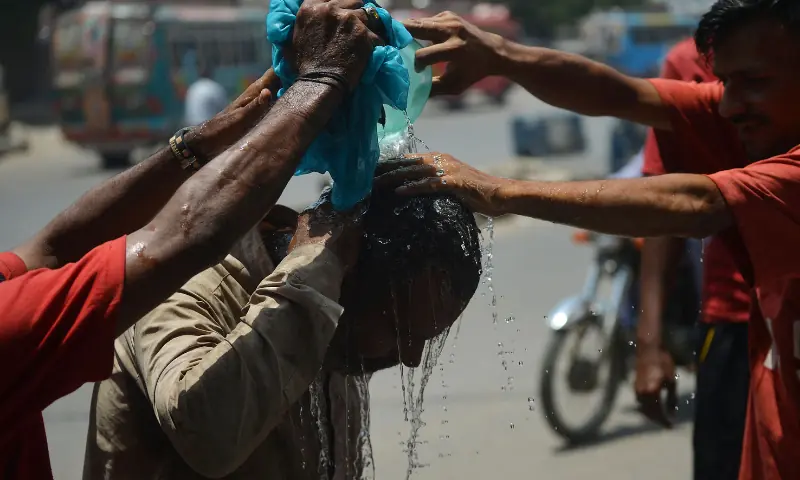
Last week, Karachi buried its dead from the first major heatstroke outbreak of 2026. By Thursday, the Pakistan Meteorological Department (PMD) warned that temperatures across Sindh and Punjab would hit 46-50°C, turning cities into pressure cookers and fields into tinderboxes. This is not an anomaly. It is a preview of Pakistan's climate future, one that will reshape its economy, its borders, and its relationships with India, Afghanistan, and beyond.
Why This Heatwave Is a National Emergency in Disguise
The heatwave gripping Pakistan is not merely a meteorological event; it is a systemic stress test. With daytime highs reaching 50°C in Jacobabad and Larkana, and Karachi hovering at 38°C under humid continental winds, the crisis is exposing the fragility of Pakistan's urban infrastructure, agricultural output, and public health systems. The NDMA's emergency protocols and hospital alerts signal that this is not a routine summer spike but a threshold event. The deaths in Karachi, the highest since 2018, are not isolated casualties; they are harbingers of a broader collapse in climate resilience. Pakistan, already ranked among the world's most vulnerable countries to climate change by the Global Climate Risk Index, is now confronting a scenario where extreme heat events are no longer episodic but structural. The question is no longer whether the system will break, but where it will fracture first: in the power grid, in the food supply, or in the streets.
This is a crisis of governance as much as of climate. The PMD's forecast is not just a weather bulletin; it is a red flag for policymakers, investors, and neighbors. The heatwave threatens to destabilize Pakistan's already fragile balance between energy demand and supply, agricultural productivity and food security, and social stability and state control. When temperatures exceed 45°C, thermal power plants derate, transmission lines sag, and urban grids collapse. When crops wilt under prolonged heat, food inflation spikes, and rural-urban migration accelerates. And when hospitals are overwhelmed, public trust in institutions erodes. The 2026 heatwave is not just a weather story, it is a geopolitical one, with ripple effects across South Asia and beyond.
The Historical Roots of Pakistan's Climate Vulnerability
Pakistan's vulnerability to extreme heat is not new. The country has endured deadly heatwaves before, in 2015, when over 1,200 people died in Karachi; in 2018, when Jacobabad hit 51°C; and in 2021, when a "wet bulb" event in Sindh forced evacuations. But the 2026 event arrives at a different juncture. Pakistan is now in the midst of a fragile economic recovery, a stalled IMF program, and a geopolitical realignment that has seen it pivot toward China, Saudi Arabia, and the Gulf while maintaining a tense standoff with India. The heatwave is testing all three pillars of Pakistan's stability: its economy, its security, and its sovereignty.
The historical parallel is the 2015 Karachi heatwave, which killed 1,200 people in a single week. That disaster exposed systemic failures in urban governance, emergency response, and public health infrastructure. It also triggered a political reckoning that led to the creation of the NDMA and the establishment of heatwave action plans. But in 2026, the stakes are higher. The 2015 crisis was localized; the 2026 crisis is national. The 2015 heatwave was a weather event; the 2026 heatwave is a climate event. And unlike 2015, Pakistan in 2026 is not just battling heat, it is battling the cumulative effects of decades of environmental neglect, unplanned urbanization, and energy mismanagement. The PMD's forecast is not just a warning; it is a post-mortem in advance.
The roots of this vulnerability stretch back to the 1960s, when Pakistan's water and energy policies prioritized large dams and thermal power over conservation and efficiency. The Indus Waters Treaty of 1960, while preventing war with India, locked Pakistan into a rigid water-sharing regime that leaves it exposed to droughts and glacial melt. The 1970s Green Revolution, while boosting food production, accelerated soil depletion and water table decline. And the 1990s energy reforms, which favored imported fuel over domestic renewables, left Pakistan dependent on volatile international markets. The result is a country that is both water-stressed and energy-deficient, a lethal combination when temperatures soar.
What Just Happened: The PMD's Forecast and the Karachi Tragedy
On Wednesday, May 6, 2026, the Pakistan Meteorological Department (PMD) issued a press release forecasting heatwave conditions across Pakistan from May 7-11. According to Dawn News, the PMD warned that high pressure in the upper atmosphere would drive temperatures to 46-50°C in southern and central districts, including Jacobabad, Larkana, and Dadu, and 39-43°C in northern cities such as Islamabad, Lahore, and Peshawar. The statement also noted that Karachi, Pakistan's largest city, would experience very hot weather with maximum temperatures between 35-38°C, accompanied by gusts of continental winds.
The PMD's forecast came just days after Karachi recorded its highest temperature since 2018, 44.1°C, and at least 10 deaths from heatstroke. Dawn News reported that the National Disaster Management Authority (NDMA) had issued sweeping emergency protocols, placing hospitals on alert and activating heatwave response plans across the country. The NDMA's intervention underscored the severity of the threat: this was not a routine weather advisory but a national emergency in waiting. The PMD's forecast extended the crisis beyond Karachi, warning that the heatwave would engulf Punjab and Sindh, the country's breadbasket and industrial heartland, before spreading to Khyber Pakhtunkhwa and Balochistan.
The PMD also noted that a shallow westerly wave would bring relief to northern Pakistan from the evening of May 10, but cautioned that the system would not penetrate the southern plains. This meant that while Peshawar and Rawalpindi might see temperatures drop, Karachi, Hyderabad, and Sukkur would remain trapped in the heat dome. The PMD advised the public, especially children, women, and senior citizens, to avoid direct sunlight, remain hydrated, and monitor vulnerable family members. Farmers were warned to adjust crop schedules and protect livestock, while urban authorities were urged to prepare for power outages and water shortages. The message was clear: this heatwave was not a drill.
Global and Regional Reactions: Who Is Responding, and How
The international response to Pakistan's heatwave has been fragmented but telling. The United Nations Office for the Coordination of Humanitarian Affairs (OCHA) issued a statement expressing concern over the "rapidly deteriorating humanitarian conditions" in Sindh and Punjab, while the World Health Organization (WHO) warned that heatwaves were "silent killers" that disproportionately affected the poor and elderly. The European Union's climate envoy, in a rare public intervention, linked the heatwave to "the accelerating climate crisis" and urged Pakistan to accelerate its renewable energy transition. Even Saudi Arabia, Pakistan's close ally, offered technical assistance through the Islamic Development Bank, signaling that climate adaptation is now a currency of soft power in South Asia.
India, Pakistan's nuclear-armed rival, has remained conspicuously silent. New Delhi has not issued any formal statement on the heatwave, nor has it offered humanitarian assistance. This reticence is not surprising given the ongoing tensions between the two countries, but it underscores a dangerous reality: climate change does not respect borders, and extreme weather events in Pakistan could spill over into India through shared rivers, migratory pressures, and energy disruptions. The absence of coordination between Islamabad and New Delhi is a reminder that South Asia's climate security architecture is stillborn.
China, Pakistan's strategic partner, has taken a more proactive stance. The Chinese Embassy in Islamabad issued a statement expressing "deep concern" over the heatwave and pledged support for Pakistan's climate adaptation efforts. This is consistent with Beijing's broader strategy of positioning itself as a leader in South-South climate cooperation, particularly through the China-Pakistan Economic Corridor (CPEC). But China's involvement is not purely altruistic. CPEC's energy projects, including the 1,320 MW Sahiwal coal plant and the 1,100 MW Port Qasim coal plant, are now at risk of derating during peak heat, threatening Pakistan's energy security and China's financial exposure. The heatwave is exposing the vulnerabilities of CPEC's energy infrastructure, which was designed for a cooler climate.
The United States, through its Agency for International Development (USAID), has pledged $5 million in emergency assistance to support heatwave response efforts, focusing on vulnerable populations in Sindh and Punjab. This marks a shift from Washington's traditional focus on counterterrorism and regional stability to climate resilience. But the aid is a drop in the ocean compared to the scale of the crisis. The real question is whether the international community will treat Pakistan's heatwave as a humanitarian emergency or as a geopolitical opportunity to expand influence in South Asia.
South Asia Impact: When Heatwaves Become Geopolitical Weapons
For Pakistan, the heatwave is a stress test of its climate governance. The PMD's forecast and the NDMA's emergency protocols are signs that the state is taking the crisis seriously, at least in the short term. But the long-term implications are more troubling. Pakistan's energy infrastructure, built for a cooler climate, is now operating at the edge of its thermal limits. Thermal power plants, which account for 60% of Pakistan's electricity, lose 1-2% efficiency for every degree above 40°C. This means that during a 50°C heatwave, power generation could drop by 10% or more, triggering blackouts that paralyze industry, agriculture, and urban life. The 2021 heatwave in Jacobabad, which caused rolling blackouts for 12 hours a day, is a harbinger of what's to come.
The heatwave is also threatening Pakistan's food security. Sindh and Punjab, the country's breadbaskets, are home to 70% of Pakistan's wheat and rice production. Prolonged heat during the critical growth phases of these crops, April to June, can reduce yields by 20-30%. This is particularly dangerous given that Pakistan is already grappling with food inflation above 30% and a stalled IMF program that has frozen wheat imports. A 20% drop in wheat production could push food inflation to 50%, triggering social unrest and further eroding public trust in the government. The 2008 food crisis, which contributed to political instability and the rise of militancy, offers a cautionary parallel. The heatwave is not just a weather event; it is a potential trigger for a new cycle of unrest.
The heatwave is also reshaping Pakistan's internal migration patterns. Rural communities in Sindh and Balochistan, already reeling from drought and water scarcity, are likely to see an exodus toward urban centers like Karachi and Hyderabad. This will exacerbate overcrowding, strain public services, and increase the risk of disease outbreaks. The 2015 Karachi heatwave, which killed 1,200 people, was exacerbated by rural-urban migration and the city's inability to absorb the influx. The 2026 heatwave could trigger a similar, but larger, crisis. For Afghanistan, which shares a porous border with Pakistan, the heatwave could accelerate migration flows into already fragile provinces like Nangarhar and Khost, where drought and conflict have already displaced millions. The heatwave is not just a Pakistani crisis; it is a regional one.
For India, the heatwave is a reminder of the shared risks of climate change. The 2022 heatwave in India, which killed 90 people and triggered power outages across 16 states, offers a stark parallel. But unlike Pakistan, India has invested in heatwave action plans, early warning systems, and urban cooling infrastructure. The absence of such measures in Pakistan is a reflection of its weaker institutions and greater vulnerability. The heatwave is exposing the asymmetry between India and Pakistan in climate resilience, an asymmetry that could deepen mistrust and reduce the prospects for regional cooperation on shared rivers and energy grids.
For China, the heatwave is a test of CPEC's climate resilience. CPEC's energy projects, which are critical to Pakistan's economic revival, are now operating in conditions they were never designed for. The 1,320 MW Sahiwal coal plant, for example, is located in a region that now regularly exceeds 50°C. Coal plants lose efficiency in extreme heat, and their cooling systems struggle to dissipate waste heat. This could reduce their output by 15-20%, threatening Pakistan's energy security and China's financial returns. The heatwave is exposing the vulnerabilities of CPEC's energy infrastructure, which was planned for a cooler climate. For South Asian readers, the real question is whether this crisis will force Beijing to rethink its energy investments in Pakistan, or whether it will double down on coal as a hedge against energy insecurity.
What Happens Next: Three Scenarios for Pakistan's Climate Future
The most likely near-term outcome is a prolonged crisis of governance. The PMD's forecast and the NDMA's emergency protocols will buy time, but they cannot address the structural causes of Pakistan's vulnerability. The heatwave will expose the weaknesses of Pakistan's energy grid, food supply chains, and public health systems, triggering a cycle of blackouts, food shortages, and social unrest. The government may impose rationing, declare a state of emergency, or seek international assistance, but none of these measures will address the root cause: Pakistan is not prepared for a 50°C future.
A second scenario is a geopolitical realignment. The heatwave could force Pakistan to accelerate its pivot toward China and Saudi Arabia, seeking financial and technical assistance for climate adaptation. This would deepen Pakistan's dependence on external patrons, but it could also provide the resources needed to upgrade its infrastructure. The risk is that this assistance comes with strings attached, for example, further Chinese control over Pakistan's energy sector or Saudi influence over its agricultural policies. The heatwave could become a catalyst for a new era of dependency, with climate adaptation tied to geopolitical leverage.
A third scenario is a regional climate security framework. The heatwave could force Pakistan and India to cooperate on shared rivers, energy grids, and early warning systems. This would require a level of trust that is currently absent, but the alternative, unchecked climate migration, food shortages, and energy disruptions, could force both countries to the table. The 2021 India-Pakistan ceasefire agreement, which reduced cross-border violence, offers a precedent for cooperation. But the heatwave is a more existential threat than a border skirmish. The real question is whether South Asia's leaders will treat climate change as a shared crisis or as a zero-sum game.The wild card is the international community. The United States, the European Union, and the United Nations are already offering assistance, but their aid is piecemeal and reactive. The real test will be whether they treat Pakistan's heatwave as a humanitarian emergency or as an opportunity to expand influence. If the international community frames the crisis as a climate justice issue, it could push for debt relief, technology transfers, and adaptation financing. But if it treats the crisis as a geopolitical chess piece, it could deepen divisions and reduce the prospects for cooperation. The heatwave is not just a Pakistani crisis; it is a global one. The question is whether the world will rise to the challenge.
Related Coverage
Global Economy Analysis → — In-depth analysis, background context, and continuous updates on this developing story.
Key Takeaways
- Pakistan's 2026 heatwave is exposing the fragility of its energy grid, food supply chains, and public health systems, with temperatures hitting 50°C in key regions and triggering blackouts, food shortages, and social unrest.
- The crisis is accelerating Pakistan's dependence on external patrons like China and Saudi Arabia, while deepening mistrust with India and exposing the vulnerabilities of CPEC's energy infrastructure.
- The heatwave is not just a Pakistani crisis, it is a regional one, with implications for Afghanistan's food security, India's energy imports, and South Asia's climate security architecture.


